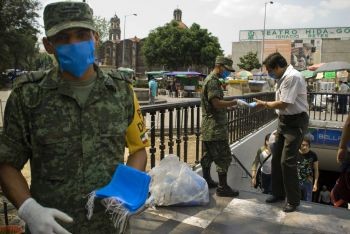
Soldiers hand out masks near a shopping mall in Mexico City after the emergence of H1N1 in April 2009. Photo Militares y Cubrebocas by eneas on Flickr (creative commons).
That a new pandemic will arrive, sooner or later, is probably the only thing about pandemic influenza upon which scientists agree. With current research and past approaches to pandemic threats proving highly controversial with both the public and scientific community, researchers at the University of Sussex have been examining new pathways to preparedness, with a new paper published today (Monday 28 January) and a high-level workshop earlier this month. These latest discussions build on years of research at the University's Centre for Global Health Policy (CGHP) and the STEPS Centre, which is based at SPRU - Science and Technology Policy Research and the Institute of Development Studies on campus. Researchers have been trying to develop a better understanding of why controversies have emerged around pandemic flu, in order to inform future approaches. In his new STEPS Centre Working Paper, To Pandemic or Not? Reconfiguring Global Responses to Influenza , Paul Forster examines the political economy of knowledge in responses to the H1N1 (swine flu) pandemic in 2009-10. Forster argues that the world would be better protected by a re-ordering of pandemic preparedness and response efforts around the needs of the world's poorest, most vulnerable, and most exposed people. This would allow the examination of the undue pre-eminence of drugs, scrutiny of contemporary agricultural practices and focus on the pressing need for disease surveillance in animals.
TO READ THIS ARTICLE, CREATE YOUR ACCOUNT
And extend your reading, free of charge and with no commitment.