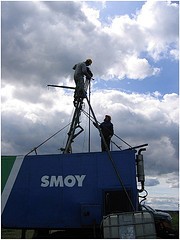
Drilling rig at the FAR DEEP site in northwestern Russia.
Penn State, PA Coalition Against Rape join to fight child sexual abuse Penn State Town Hall Forum provides open discussion Football head coach search committee formed University launches hotline for reporting abuse Student government leaders to host forum for students, administrators UNIVERSITY PARK, Pa. The appearance of oxygen in the Earth's atmosphere probably did not occur as a single event, but as a long series of starts and stops, according to an international team of researchers who investigated rock cores from the FAR DEEP project. The Fennoscandia Arctic Russia - Drilling Early Earth Project - FAR DEEP - took place during the summer of 2007 near Murmansk in the northwest region of Russia. The project, part of the International Continental Scientific Drilling Program, drilled a series of shallow, two-inch diameter cores and, by overlapping them, created a record representing stone deposited during the Proterozoic Eon - 2,500 million to 542 million years ago. "We've always thought that oxygen came into the atmosphere really quickly during an event," said Lee R. Kump, professor and head of geosciences, Penn State. "We are no longer looking for an event. Now we are looking for when and why oxygen became a stable part of the Earth's atmosphere." The researchers report in today's (Dec.
TO READ THIS ARTICLE, CREATE YOUR ACCOUNT
And extend your reading, free of charge and with no commitment.