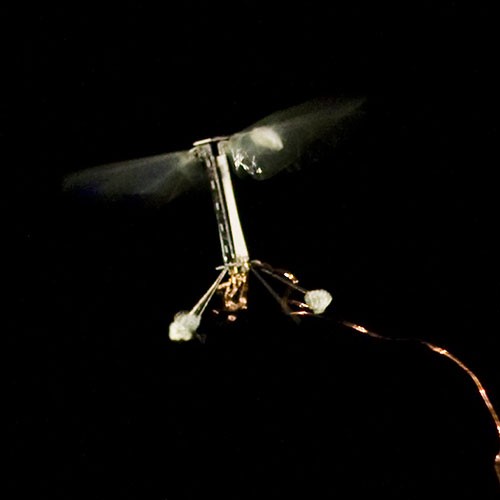
Inspired by the biology of a fly, with submillimeter-scale anatomy and two wafer-thin wings that flap almost invisibly, 120 times per second, this tiny robot has taken its first controlled flight. (Photo courtesy of Kevin Ma and Pakpong Chirarattananon.)
In culmination of a decade's work, RoboBees achieve vertical takeoff, hovering, and steering. Caroline Perry , (617) 496-1351 In the very early hours of the morning, in a Harvard robotics laboratory last summer, an insect took flight. Half the size of a paperclip, weighing less than a tenth of a gram, it leapt a few inches, hovered for a moment on fragile, flapping wings, and then sped along a preset route through the air. Like a proud parent watching a child take its first steps, graduate student Pakpong Chirarattananon immediately captured a video of the fledgling and emailed it to his adviser and colleagues at 3 a.m.-subject line, "Flight of the RoboBee." "I was so excited, I couldn't sleep," recalls Chirarattananon, co-lead author of a paper published this week in Science. The demonstration of the first controlled flight of an insect-sized robot is the culmination of more than a decade's work, led by researchers at the Harvard School of Engineering and Applied Sciences (SEAS) and the Wyss Institute for Biologically Inspired Engineering at Harvard. "This is what I have been trying to do for literally the last 12 years," says Robert J. Wood , Charles River Professor of Engineering and Applied Sciences at SEAS, Wyss Core Faculty Member, and principal investigator of the National Science Foundation-supported RoboBee project. "It's really only because of this lab's recent breakthroughs in manufacturing, materials, and design that we have even been able to try this.
TO READ THIS ARTICLE, CREATE YOUR ACCOUNT
And extend your reading, free of charge and with no commitment.