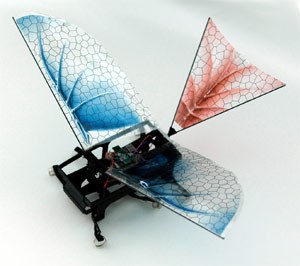
DASH+Wings showed the possibility of using robotic models to provide insight into biological performance. (Image by Kevin Peterson, Biomimetic Millisystems Lab)
When engineers at the University of California, Berkeley, outfitted a six-legged robotic bug with wings in an effort to improve its mobility, they unexpectedly shed some light on the evolution of flight. Even though the wings significantly improved the running performance of the 10-centimeter-long robot - called DASH, short for Dynamic Autonomous Sprawled Hexapod - they found that the extra boost would not have generated enough speed to launch the critter from the ground. The wing flapping also enhanced the aerial performance of the robot, consistent with the hypothesis that flight originated in gliding tree-dwellers. The research team, led by Ron Fearing, professor of electrical engineering and head of the Biomimetic Millisystems Lab at UC Berkeley, reports its conclusions online Tuesday, Oct. 18, in the peer-reviewed journal Bioinspiration and Biomimetics . Using robot models could play a useful role in studying the origins of flight, particularly since fossil evidence is so limited, the researchers noted. First unveiled by Fearing and graduate student Paul Birkmeyer in 2009, DASH is a lightweight, speedy robot made of inexpensive, off-the-shelf materials, including compliant fiber board with legs driven by a battery-powered motor.
TO READ THIS ARTICLE, CREATE YOUR ACCOUNT
And extend your reading, free of charge and with no commitment.