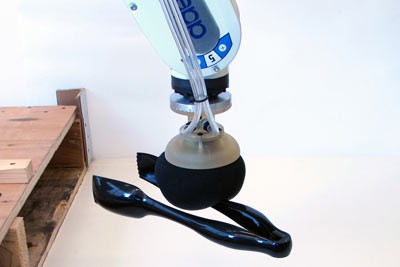
The universal jamming gripper picking up a pair of tongs. The trick is to decide where to grab.
When Cornell engineers developed a new type of robot hand that could pick up oddly shaped objects it presented a challenge: It was easy for a human operator to choose the best place to take hold of an object, but an autonomous robot, like the ones we may someday have helping around the home or office, would need a new kind of programming. So they have developed a procedure - an algorithm - that allows a robot to learn grasping skills from experience and apply them in new situations. Although inspired by the "universal jamming gripper" created in the lab of Hod Lipson, associate professor of mechanical engineering and computer science, the new method is "hardware agnostic," the researchers said, and will work with any type of robot gripper. The work by Lipson and Ashutosh Saxena, assistant professor of computer science, a specialist in "machine learning," will be presented May 16 at the International Conference on Robotics and Automation in St. Paul, Minn. Co-authors of their paper are graduate students Yun Jiang and John Amend. Lipson's gripper consists of a flexible bag filled with a granular material. As the bag settles on an object it deforms to fit, then air is sucked out of the bag, causing the granules to pull together and tighten the grip.
TO READ THIS ARTICLE, CREATE YOUR ACCOUNT
And extend your reading, free of charge and with no commitment.