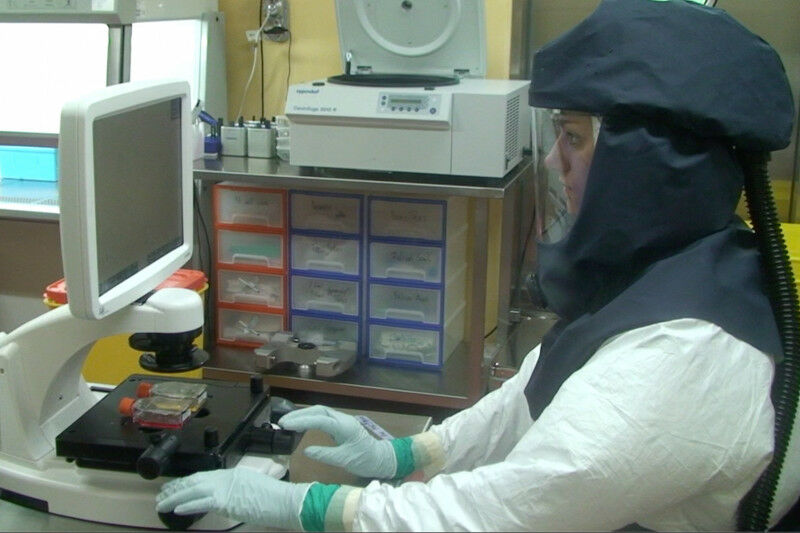
 Working at the high-security laboratory of the Institute of Virology and Immunology (IVI.
Working at the high-security laboratory of the Institute of Virology and Immunology (IVI. IVI - How dangerous are new mutations of the SARS-CoV-2 virus? An international team involving researchers from the Institute of Virology and Immunology (IVI) of the Federal Food Safety and Veterinary Office BLV and the University of Bern (Switzerland), the Centers for Disease Control and Prevention (USA), and the Friedrich-Loeffler Institute (Germany), has developed an approach that can accurately assess the transmissibility of new virus mutants. Prior to the emergence of new mutants of the coronavirus, such as the British variant B.1.1.7, the SARS-CoV-2 variant named D614G had already mutated from the original SARS-CoV-2 pathogen that triggered the pandemic. D614G has rapidly spread to become the most abundant variant worldwide and this D614G mutation remains in all the new emerging variants. An international team including researchers from Bern has now been able to demonstrate in both the laboratory and in animal models why the D614G variant was able to gain the upper hand over the original SARS-CoV-2 virus. "Our approach also allows us to characterize emerging mutations such as the British variant B.1.1.7 better and quicker," says Volker Thiel of the Institute of Virology and Immunology (IVI), one of the four lead authors of the study. The findings are extremely important for assessing the risk of new mutants running rampant, as they show how a fitness advantage of virus variants can lead to higher transmission.
TO READ THIS ARTICLE, CREATE YOUR ACCOUNT
And extend your reading, free of charge and with no commitment.
Your Benefits
- Access to all content
- Receive newsmails for news and jobs
- Post ads