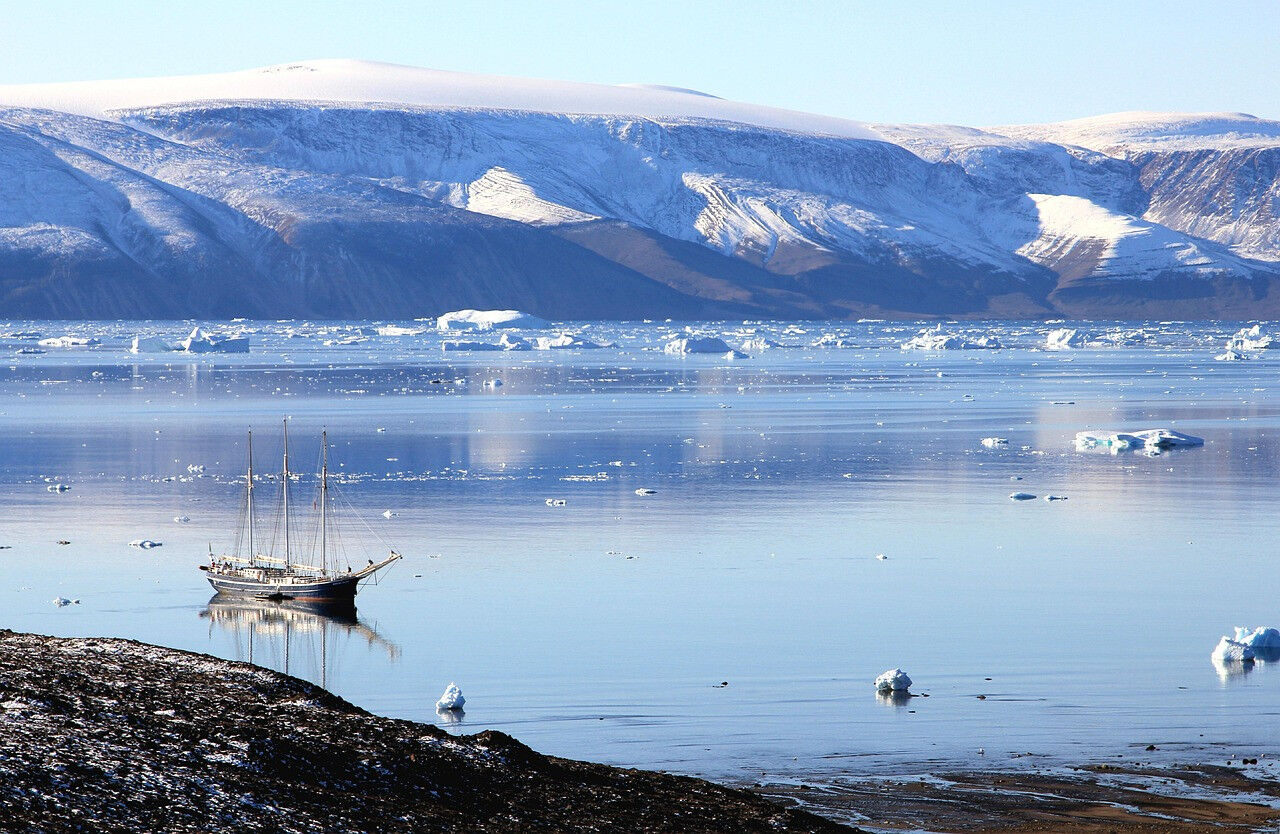
A meltwater lake has been floating on the 79°N glacier, one of three parts of the Greenland ice sheet, since the 1990s. It is now 21 km2 in size. An international research team led by Holger Steeb from the SimTech Cluster of Excellence at the University of Stuttgart, together with partners from the Alfred Wegener Institute (AWI) and TU Darmstadt, has investigated how this lake has formed - and how repeated, abrupt drainage over the years has cut deep, triangular cracks, known as moulins, into the ice. The results have now been published in the scientific journal The Cryosphere.
In addition to the analysis of satellite images and radar data, modeling played a key role in allowing the complex material properties of glacier ice - its simultaneous viscous and elastic nature - to be physically reproduced correctly.
"The numerical models show how the drainage channels deform during and after a drainage event," explains Holger Steeb, spokesperson for the Collaborative Research Center 1313 "Interface-driven Multi-field Processes in Porous Media". the simulations explain how the cross-section of a channel changes under the influence of water and ice movement, whether it closes again over weeks and months or remains open for years and is reactivated. The behavior of these channels is crucial for understanding how quickly and to what extent meltwater flows from the ice sheet into the sea."
The modeling thus forms the bridge between observations from space and direct measurements in the field. They show why some moulins remain stable for years, while others disappear quickly. They also explain how stresses and strains in the ice affect the formation of cracks. And how the cracks accelerate the transport of meltwater to the base of the glacier.
Since the supraglacial lake was first observed in 1995, there have been a total of seven drainage events - four of them in the last five years alone. Since 2019 in particular, new, large triangular fracture fields have appeared. These moulins have openings of several dozen meters and channel huge amounts of water to the base of the ice sheet within hours.
"The viscoelastic material behavior of glacier ice is central to these processes," says Holger Steeb. "The elastic component allows the cracks to form, while the viscous component ensures that channels close again over time - or reopen in subsequent years under certain conditions. It is precisely this interplay that we were able to reproduce with the numerical simulations."
The new findings are not only important for glaciology, but also for climate research, coastal protection and political decisions. By integrating the processes of crack formation and drainage into ice sheet models, future meltwater volumes and their influence on global sea level rise can be estimated more precisely. This is an important basis for assessing risks for coastal regions worldwide, planning protective measures and better limiting the consequences of climate change.
The study was carried out in collaboration between the SimTech Cluster of Excellence and the Institute of Mechanics (Civil Engineering) at the University of Stuttgart, the Alfred Wegener Institute, TU Darmstadt and other international partners.
Original publication
Humbert, A., Steeb, H., et al. (2025): Insights into supraglacial lake drainage dynamics: triangular fracture formation, reactivation and long-lasting englacial features. The Cryosphere. https://doi.org/10.5194/tc-19-3009-2025