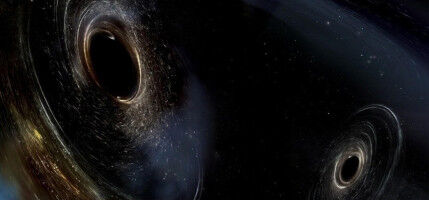
In this artist’s rendering, a thick accretion disk has formed around a supermassive black hole following the tidal disruption of a star that wandered too close. Stellar debris has fallen toward the black hole and collected into a thick chaotic disk of hot gas. Flashes of X-ray light near the center of the disk result in light echoes that allow astronomers to map the structure of the funnel-like flow, revealing for the first time strong gravity effects around a normally quiescent black hole.
In the center of a distant galaxy, almost 300 million light years from Earth, scientists have discovered a supermassive black hole that is 'choking' on a sudden influx of stellar debris. In a paper published today in Astrophysical Journal Letters , researchers from MIT, NASA's Goddard Space Flight Center, and elsewhere report on a 'tidal disruption flare' - a dramatic burst of electromagnetic activity that occurs when a black hole obliterates a nearby star. The flare was first discovered on Nov. 11, 2014, and scientists have since trained a variety of telescopes on the event to learn more about how black holes grow and evolve. The MIT-led team looked through data collected by two different telescopes and identified a curious pattern in the energy emitted by the flare: As the obliterated star's dust fell into the black hole, the researchers observed small fluctuations in the optical and ultraviolet (UV) bands of the electromagnetic spectrum. This very same pattern repeated itself 32 days later, this time in the X-ray band. The researchers used simulations of the event performed by others to infer that such energy 'echoes' were produced from the following scenario: As a star migrated close to the black hole, it was quickly ripped apart by the black hole's gravitational energy.
TO READ THIS ARTICLE, CREATE YOUR ACCOUNT
And extend your reading, free of charge and with no commitment.