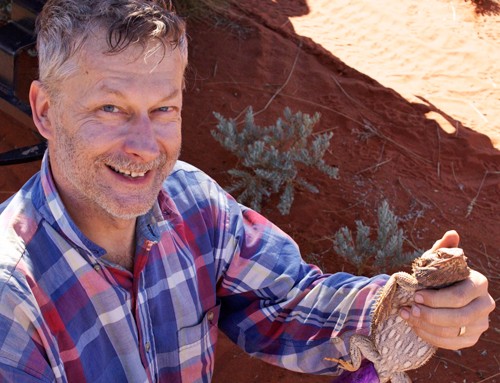
Professor Chris Dickman in the Simpson Desert.
Results from a unique 20-year study of the ecology of the Simpson Desert will be revealed on Thursday 12 August, when Professor Chris Dickman from the School of Biological Sciences presents his Sydney Science Forum presentation, Some Like It Hot . With arid zones making up 70 percent of Australia, this long-term ecological research has collected important data uncovering patterns of biodiversity which impact Australia's environment and give insight into how ecological patterns will be affected by climate change. The Simpson Desert hosts a huge diversity of life, despite being an arid environment with temperatures ranging from minus 8 degrees in winter to over 50 degrees in summer. There are more than 150 bird species, 17 small mammal species, four types of frog and 54 reptile species - the highest reptile biodiversity of any arid zone in the world. Professor Dickman , who founded and leads the University of Sydney's Desert Ecology Research Group, has followed the extraordinary 'boom' and 'bust' cycles that characterise inland Australia over 20 years of continuous research in the Simpson Desert. His team have uncovered the amazing adaptations that frogs and desert mice use to cope with the extreme conditions; how floods, wildfires and invasive species affect the native small mammals; and how so many species seem to appear and disappear at different times and places over the desert landscape. With the spectre of climate change looming, life in Australia's central deserts may provide a glimpse of what the continent's coastal fringes can expect in future.
TO READ THIS ARTICLE, CREATE YOUR ACCOUNT
And extend your reading, free of charge and with no commitment.