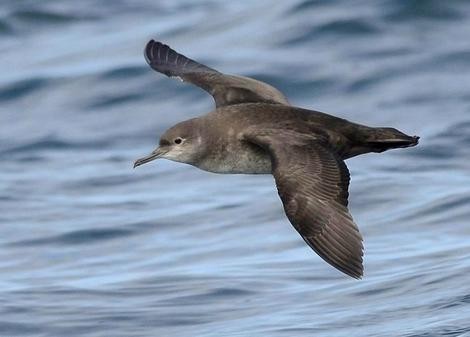
Little is known about the Shearwater’s life at sea. Photo: Mark Darlaston
Male and female Balearic Shearwaters may head for different migration hotspots over the summer period a new study suggests. The Balearic Shearwater is a frequent visitor to southern UK coastal waters, yet with just 3,200 estimated breeding pairs left in existence it is the only European seabird to be officially classified as Critically Endangered. Accidental by-catch in fishing gear is thought to be its greatest threat away from land, but surprisingly little is known about this species' elusive life at sea. In a study published this week in PLoS ONE, scientists from Oxford University's Department of Zoology led by Professor Tim Guilford, together with colleagues at the National Oceanography Centre in Southampton, the British Geological Survey, and local scientists from Mallorca, have, for the first time, succeeded in tracking the bird's at-sea movements year-round using miniature geolocation devices. For most of the year shearwaters feed over the Iberian shelf in the western Mediterranean, close to their breeding colonies in caves on remote coasts of the Spanish Balearic Islands. Then, at the end of June, the shearwaters make a three-month migration out of the Mediterranean to feed in productive waters along the Atlantic coasts of Iberia and France. In 2010, 26 individuals were successfully tracked from a colony on Mallorca and, although all made the post-breeding Atlantic migration, none reached the UK.
TO READ THIS ARTICLE, CREATE YOUR ACCOUNT
And extend your reading, free of charge and with no commitment.