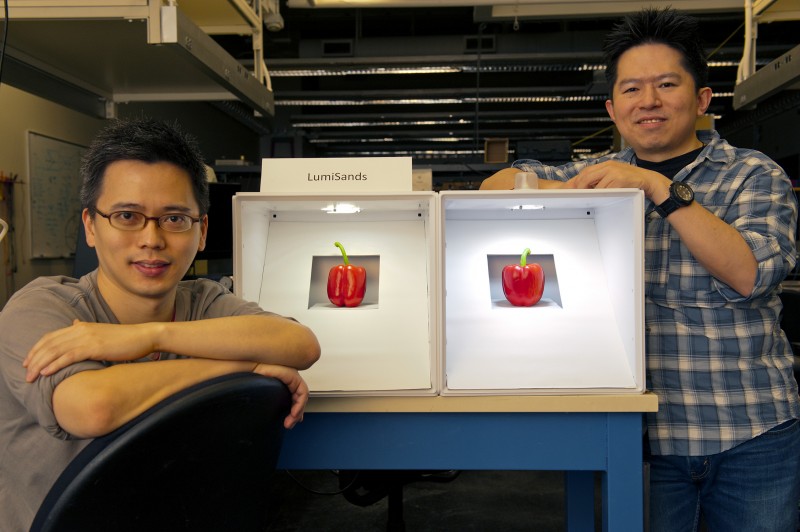
Mary Levin, UW LumiSands cofounders Chang-Ching Tu, left, and Ji Hoo with with a demo showing the warmer, softer hue of the LED bulb (left side) after a film embedded with their red-emitting silicon nanoparticles is placed underneath. The box on the right is an identical, standard LED bulb.
Posted under: Engineering , Research , Science , Technology , UW and the Community. Light-emitting diodes, or LEDs, are the most efficient and environmentally friendly light bulbs on the market. But they come at a higher up-front price than other bulbs, especially the ones with warmer and more appealing hues. Researchers at the University of Washington have created a material they say would make LED bulbs cheaper and greener to manufacture, driving down the price. Their silicon-based nanoparticles soften the blue light emitted by LEDs, creating white light that more closely resembles sunlight. The company, LumiSands , started as a graduate student project for CEO Chang-Ching Tu, who received his doctorate in electrical engineering at the UW and just completed a stint as a postdoctoral researcher in materials science and engineering. This spring, the start-up company spun out from the UW Center for Commercialization , a process that its two founders hope will lead to signing a commercialization license for the technology.
TO READ THIS ARTICLE, CREATE YOUR ACCOUNT
And extend your reading, free of charge and with no commitment.