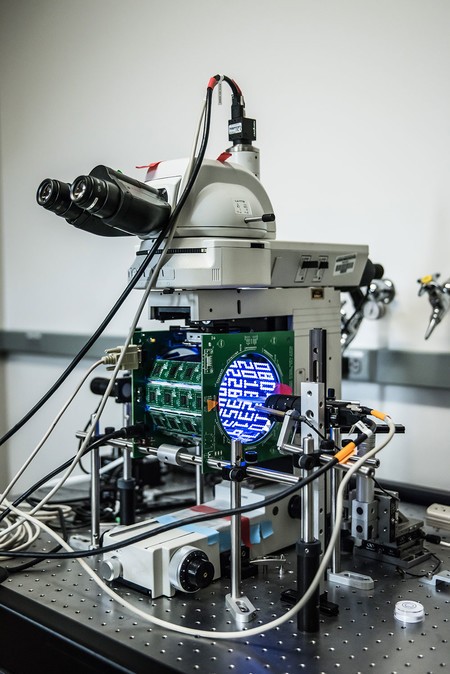
The fruit fly flight simulator.
Fruit flies are capable of impressive aerial maneuvers, as is grudgingly acknowledged by anyone who has unsuccessfully tried to swat away one of the familiar kitchen pests. Interestingly, the flies perform these nimble evasive movements using only 12 flight muscles, each controlled by one brain cell, or neuron. In comparison, hummingbirds can produce almost identical aerial patterns but use 100 times more neurons per muscle. Now, new research from Caltech provides the first understanding into how so few muscles produce such complex flight. The findings, an advance at the intersection of biomechanics and neurobiology, are described in a paper appearing in the January 26 issue of Current Biology . Key to understanding how flies control their flight is their complex wing hinge'the elaborate joint that transforms the action of muscles inside the body into the sweeping motion of the wing. "Because the wings of birds, bats, and pterosaurs evolved from limbs, they are equipped with shoulder, elbow, wrist, and finger joints'each with their own set of muscles," says Michael Dickinson , Caltech's Esther M. and Abe M. Zarem Professor of Bioengineering.
TO READ THIS ARTICLE, CREATE YOUR ACCOUNT
And extend your reading, free of charge and with no commitment.