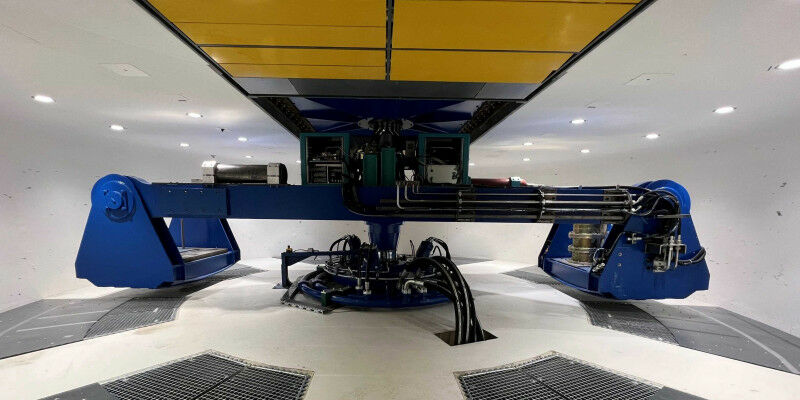
A giant metal door leads to a bright, circular underground room. This is home to the crowning glory of the Geotechnical Centrifuge Center (GCC): the blue beam centrifuge, measuring a total of some nine metres. Constructing this research facility was no mean feat - but the builders rose to the challenge. To prevent interference with highly sensitive measurements in laboratories surrounding the GCC, the centrifuge chamber is vibration-isolated and rests on four steel spring units. Europe’s largest-capacity centrifuge has been operational and delivering research data since June 2023, but today ETH Zurich is celebrating this extraordinary piece of infrastructure on a very special date.
This is a day that Ioannis Anastasopoulos, Professor of Geotechnical Engineering and Head of the Department of Civil, Environmental and Geomatic Engineering at ETH Zurich, has been anticipating for a long time. It’s no coincidence that the inauguration of the centrifuge falls precisely on 17 January 2025. While Anastasopoulos didn’t want to turn up to this ceremony empty-handed, preferring instead to have some first research results to present, this date is of great personal significance to him. Today is the 30th anniversary of the 1995 Great Hanshin Earthquake, which devastated the city of Kobe in Japan. At the time of the disaster, Anastasopoulos was a civil engineering student. The event was instrumental to his future career, as it led to the decision to dedicate himself to geotechnical earthquake engineering.
Giving new life to an old centrifuge
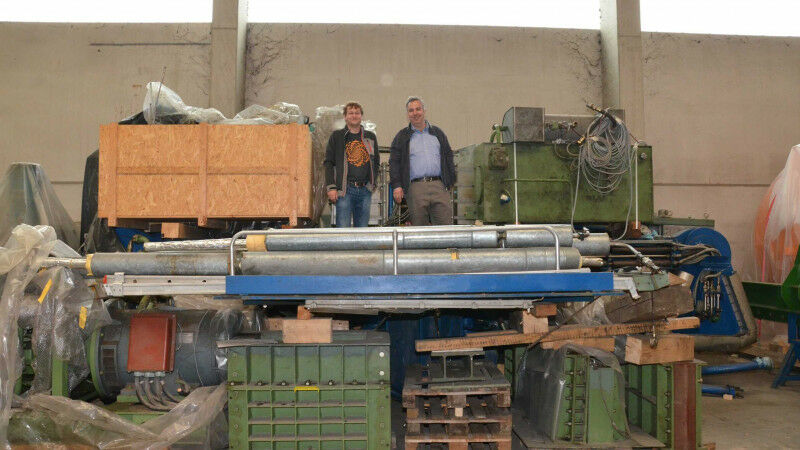
While this may look like ultra-modern research infrastructure, it in fact already has a few stories to tell from its past life. ETH made the conscious decision not to acquire a new centrifuge, but rather to buy a centrifuge from Ruhr University Bochum that had been decommissioned. Although a complete overhaul was needed and new parts had to be fitted, this approach only cost around one-quarter as much as purchasing a new centrifuge of the same capacity.Refurbishing and modernising a centrifuge of this size is a daunting task. The refurbishment was performed in parallel to the construction of the facility at Hönggerberg. Both were delayed by the Covid pandemic and resulting supply-chain disturbances. But despite all these challenges, the centrifuge was put into operation just one year later than originally planned. For Anastasopoulos, this was a resounding success: "At times, we weren’t sure when the centrifuge would actually be up and running, and quite a few projects depend on it. So we are happy to be able to produce some first experimental results."
A whirlwind of activity
The new "old" centrifuge has been in action for some eighteen months and is operating at full capacity. It is generally used to conduct one to three tests per week. Anastasopoulos is supported by a team of 10-15 researchers and technicians, all working to ensure that experiments can be conducted and that the centrifuge functions properly.The frequency of the experiments depends on the complexity of the model being tested. Preparing the model takes up most of the time, because the structural and geotechnical conditions have to be reproduced as realistically as possible. Thanks to the additional g-forces generated by this extraordinary centrifuge, effects that take years to manifest in the real world can be simulated in a matter of just a few hours.
Wind farms, bridges, Brienz and Leimbach
The centrifuge can be put to a multitude of uses. One example of research currently being conducted at the GCC is related to the foundations of offshore wind turbines, which are crucial for the transition to renewable energy. Far out at sea, wind turbines are exposed to all kinds of natural hazards. Exposed to storms and earthquakes, such structures are prone to tilting, which calls for our improved understanding of their mechanical response. An inclination of just 0.5 degrees can damage the mechanical systems and greatly reduce the service life of a wind farm.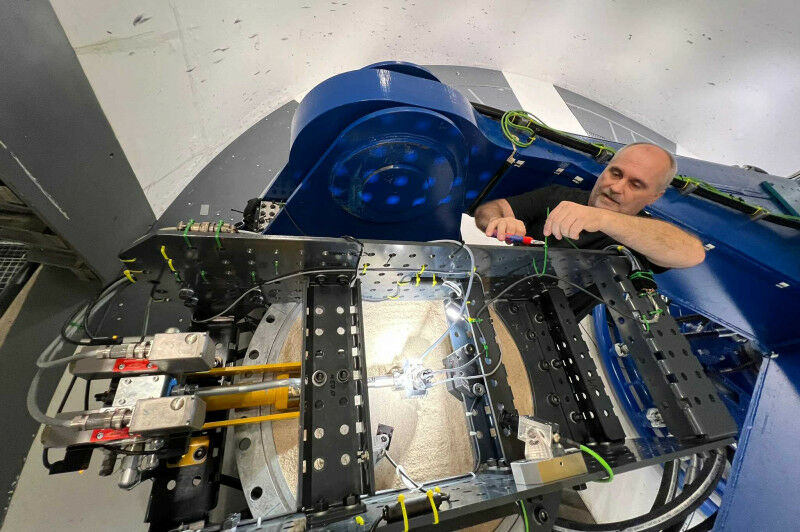
In the canton of Graubünden, the entire village of Brienz is under threat from ground movements, while the Leimbach area of Zurich is constantly moving due to a slow creeping landslide. Here, the centrifuge could help us to better understand the causes of failure and the processes that lead to such massive movements, contributing to the quantification of risk for the affected population.
With such diverse research topics and areas of application, it’s clear that the centrifuge has a busy future ahead.