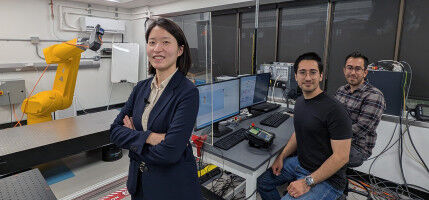
Stanford Bio-X researchers develop new technology to study hearing
Stanford researchers have received Bio-X funding to develop a tiny moving probe to study the mechanical properties of sensory cells in the ear. Their research could lead to new treatments for hearing loss, and the probe may advance other scientists' research as well. Much of what is known about sensory touch and hearing cells is based on indirect observation. Scientists know that these exceptionally tiny cells are sensitive to changes in force and pressure. But to truly understand how they function, scientists must be able to manipulate them directly. Now, Stanford scientists are developing a set of tools that are small enough to stimulate an individual nerve or group of nerves, but also fast and flexible enough to mimic a realistic range of forces. A team of mechanical engineers from Stanford and ear specialists from the Stanford School of Medicine is developing a new device, known as a force probe, that allows the researchers to study the flexible hair cells that translate sound waves into electrical signals.