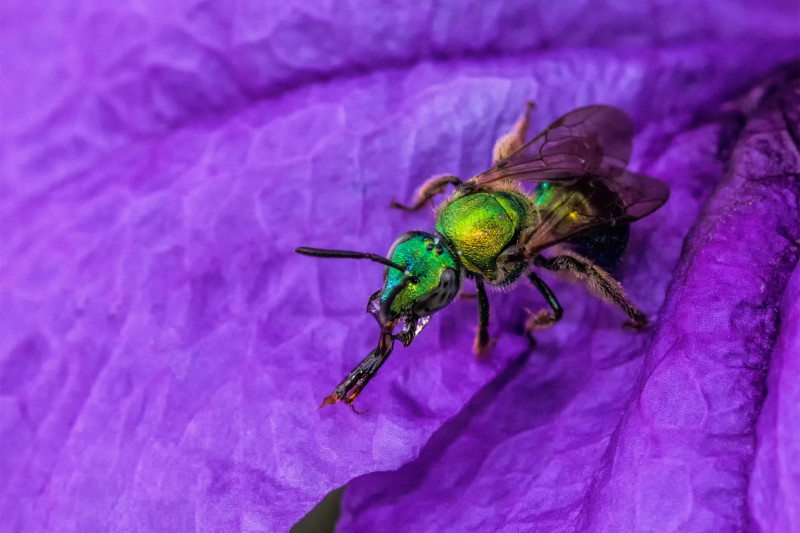
Wild bees, like this Augochlora Sweat Bee, are more resilient to attacks from murder hornets - as well as to disease and other social threats - because of their solitary nesting style. (Image credit: Larry Crovo, Flickr)
Wild bees, like this Augochlora Sweat Bee, are more resilient to attacks from murder hornets - as well as to disease and other social threats - because of their solitary nesting style. (Image credit: Larry Crovo, Flickr) Experts from the Stanford-based Natural Capital Project explain the value of wild bees in our agricultural systems, especially in light of the increased risk murder hornets pose to domesticated honey bees. The Asian giant hornet, also known as the "murder hornet," isn't likely to sting a human unless provoked, but its presence in North America could seriously impact access to our food supply. Murder hornets have an appetite for honey bees, which are the most important source of pollination for the majority of our crops. Rebecca Chaplin-Kramer and Eric Lonsdorf, scientists at the Natural Capital Project , study the contributions - such as pollination - that bees provide to people. Their research focuses on the benefits of wild bees, which are less social than honey bees, to ecosystems and the importance of valuing those contributions so that they may be used to create more sustainable agricultural landscapes. Below, Chaplin-Kramer and Lonsdorf discuss the threat that murder hornets pose to U.S. honey bees and why it is so important to protect the habitats of more resilient wild bee species in our agricultural lands.
TO READ THIS ARTICLE, CREATE YOUR ACCOUNT
And extend your reading, free of charge and with no commitment.