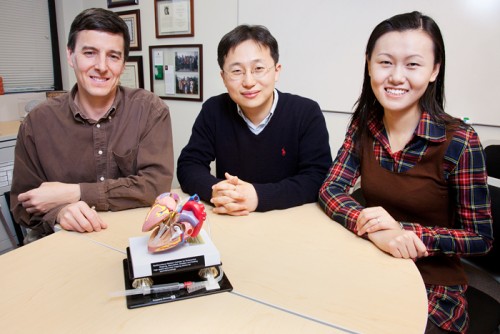
John Rogers, left, a professor of materials science and engineering, led a team of materials scientists, mechanical and electrical engineers, and physicians, including postdoctoral researchers Dae-Hyong Kim, center, and Nanshu Lu to successfully integrate stretchable electronics technology with standard endocardial balloon catheters.
CHAMPAIGN, Ill. Cardiologists may soon be able to place sensitive electronics inside their patients' hearts with minimal invasiveness, enabling more sophisticated and efficient diagnosis and treatment of arrhythmias. A team of materials scientists, mechanical and electrical engineers, and physicians has successfully integrated stretchable electronics technology with standard endocardial balloon catheters. Led by John A. Rogers, the Lee J. Flory-Founder Chair in Engineering at Illinois, the team published its work in the March 6 online edition of Nature Materials. The team previously demonstrated a sensor-laden sheet that could laminate to the surface of the heart in 2010. Now they have expanded their technology to endocardial balloon catheters, one of the most common, least-invasive devices for cardiac procedures. Catheters are long, flexible tubes that can be threaded through a vein or artery to reach the inside of the heart.
TO READ THIS ARTICLE, CREATE YOUR ACCOUNT
And extend your reading, free of charge and with no commitment.