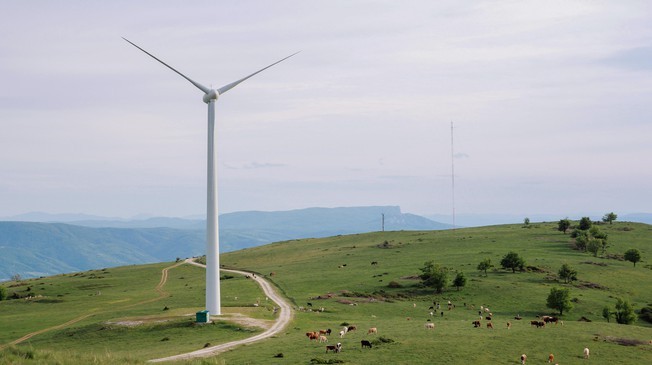
 A wind turbine in the Romanian Carpathians.
EPFL researchers have developed a simulator that can calculate the performance of wind farms over 30 years while also factoring in the need to preserve local biodiversity. Tested at a site in the Carpathian Mountains in Romania, the simulator could be applied to the Swiss Jura region, which has a similar landscape. Three EPFL labs were involved in developing the model in partnership with the University of Bucharest in Romania. Researchers from the Wind Engineering and Renewable Energy Laboratory (WIRE), the Ecological Systems Laboratory (ECOS) and the Laboratory of Geographic Information Systems (LASIG) pooled their data and models with those of experts from the University of Bucharest's Centre of Landscape-Territory-Information Systems (CeLTIS) as part of a ground-breaking initiative in wind energy. Their aim is to provide the local authorities with a model they can use to simulate in a given landscape the wind energy potential in the long term, taking into account the evolution of the landscape and its biodiversity: the model allows to integrate for instance the role of agricultural land use. This is important for striking the right balance between arable land and pastureland, which can help to generate strong winds, and natural woodland, where the trees tend to reduce the performance of wind farms. The case study simulated the impact of land use policy on wind energy potential and biodiversity in the Southern Carpathians, even though no such project is in the pipeline for the moment. Don't shoot for maximum production
TO READ THIS ARTICLE, CREATE YOUR ACCOUNT
And extend your reading, free of charge and with no commitment.
Your Benefits
- Access to all content
- Receive newsmails for news and jobs
- Post ads