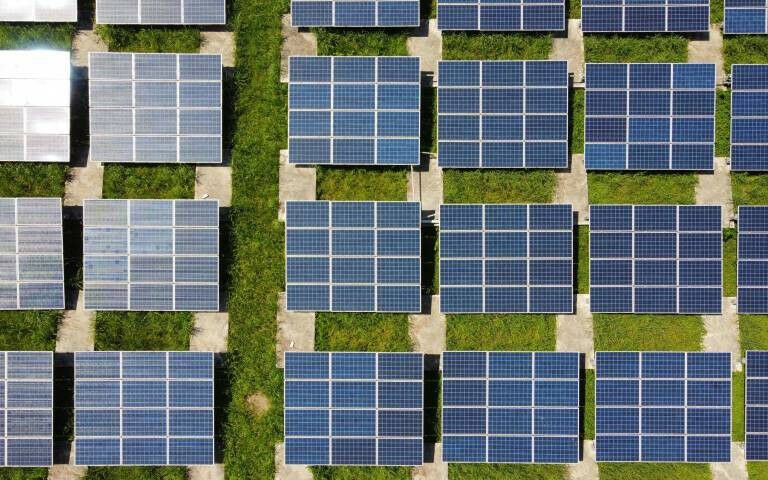
solar panels from above
solar panels from above - UCL's Artificial Intelligence Society has launched an international competition, Climate Hack.AI, in which students at 25 universities will compete to use AI to help reduce global carbon emissions. Over two months, students will improve upon state-of-the-art methods predicting solar energy production in the near future (solar photovoltaic nowcasting) based on satellite images showing cloud cover. Better predictions will allow grid operators to minimise the use of standby power from non-renewable sources, reducing carbon emissions. The competition is co-hosted by student societies at 25 universities including UCL, Harvard, MIT, Stanford, Oxford and Cambridge. It is a collaboration with Open Climate Fix, non-profit organisation that has prepared about 100 gigabytes of earth satellite imagery - data which students will use to train machine learning algorithms. Open Climate Fix estimates that better solar photovoltaic forecasting could save up to 100 kilotonnes per year in the UK alone, and by 2030, reduce global carbon emissions by roughly 100 million tonnes per year. The winning team will be awarded £30,000 and their model could be deployed, via Open Climate Fix, by the UK's National Grid Electricity System Operator to produce more accurate solar photovoltaic output forecasts.
TO READ THIS ARTICLE, CREATE YOUR ACCOUNT
And extend your reading, free of charge and with no commitment.