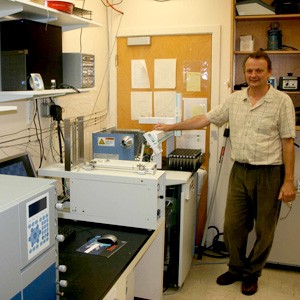
Peter Swart and his team in the Stable Isotope Laboratory are using the latest tools, including mass spectrometry, to analyze geochemical signatures.
— Coral Gables — In a study published in the journal Geology, scientists at the University of Miami suggest that significant changes in the carbon isotopic composition of carbonates, which occurred prior to the major climatic event (Snowball Earth) of more than 500 million years ago, are unrelated to worldwide glacial events. "Our study suggests that the geochemical record documented in rocks prior to the Marinoan glaciation, or Snowball Earth, are unrelated to the glaciation itself," said Peter Swart, professor of marine geology and geophysics at UM's Rosenstiel School of Marine and Atmospheric Science and co-author of the study. "Instead, the changes in the carbon isotopic ratio are related to alteration by freshwater as sea level fell." To better understand the environmental conditions prior to Snowball Earth, the research team analyzed geochemical signatures preserved in carbonate rock cores from similar climactic events that occurred more recently-two million years ago-during the Pliocene-Pleistocene period. The team analyzed the ratio of the rare isotope of carbon (13C) to the more abundant carbon isotope (12C) from cores drilled in the Bahamas and the Enewetak Atoll in the Pacific Ocean. The geochemical patterns that were observed in these cores were nearly identical to the pattern seen prior to the Marinoan glaciation, which suggests that the alteration of rocks by water, a process known as diagenesis, is the source of the changes seen during that time period.
TO READ THIS ARTICLE, CREATE YOUR ACCOUNT
And extend your reading, free of charge and with no commitment.