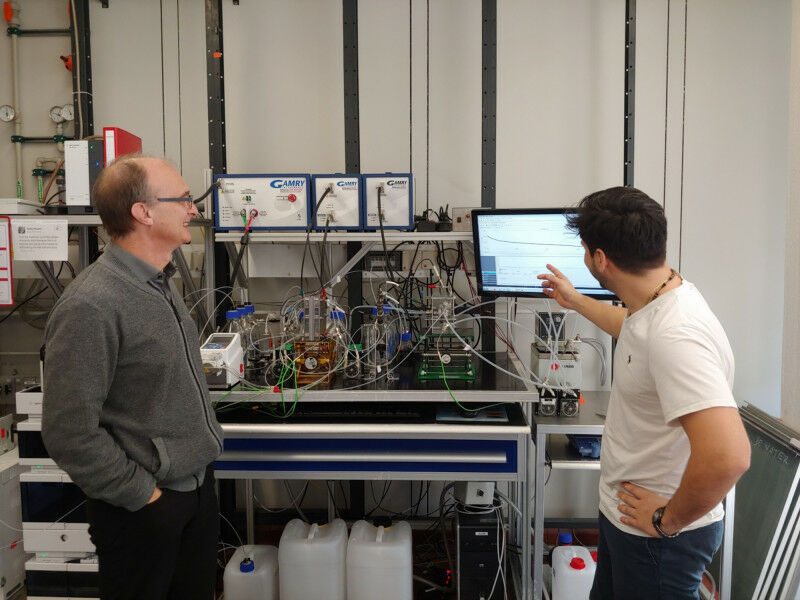
University of Stuttgart establishes research initiative CHEM|ampere [Picture: Universität Stuttgart/ITC]
By 2050, the chemical industry should operate in a climate neutral fashion, which means phasing-out fossil oil, gas and coal. Therefore alternative carbon sources and renewable energy have to be utilized in order to replace fossil reserves. A new Stuttgart Research Initiative will elaborate on the concept of such a future chemical factory, both from a fundamental and application-oriented standpoint. The University of Stuttgart, German Aerospace Center (DLR), the Center for Solar Energy and Hydrogen Research Baden-Württemberg (ZSW) and the Fraunhofer Institute for Interfacial Engineering and Biotechnology (IGB) will be involved in the initiative. According to the Climate Action Plan 2030, as enacted by the Climate Cabinet of the German government, all sectors - including the chemical industry - must cut their greenhouse gas emissions to 55 % of their 1990 level. Despite significant increase of the process efficiency by the chemical industry in past decades, the long-term goal of the Climate Action Plan 2050 to become largely greenhouse-gas neutral by 2050 is only possible through new disruptive technologies and processes. Especially when considering the fossilbased raw materials used in chemical production, the goal must be to close the carbon cycle by moving to non-fossil based raw materials.
TO READ THIS ARTICLE, CREATE YOUR ACCOUNT
And extend your reading, free of charge and with no commitment.