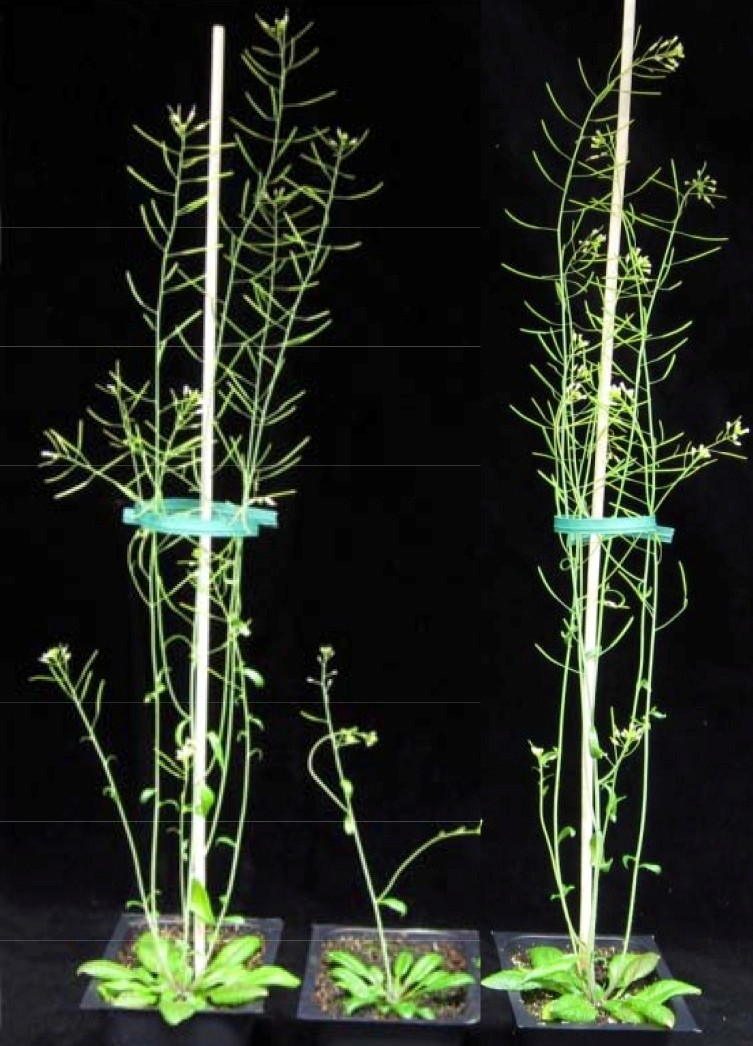
On the right is an Arabidopsis plant engineered to reduce the xylan content while preserving the structural integrity of its cell walls. It compares favorably to wild type plant on the far left. In the middle is a xylan-deficient mutant.
Xylan is a polysaccharide composed of pentoses - five carbon sugars - that represents a double-edged sword for advanced biofuels. On the one hand, as the world's second most abundant source of biomass after cellulose, xylan is an enormous source of stored solar energy. On the other hand, the presence of xylan makes it more difficult to extract the hexoses - six carbon sugars - in cellulose that are more easily fermented into biofuels than pentoses. Researchers at the U.S. Department of Energy (DOE)'s Joint BioEnergy Institute (JBEI) are using the tools of synthetic biology to beat this double-edged sword into plowshares. In one study, they engineered plants with more extractable xylan. Now they have engineered plants with low xylan content and a higher proportion of cellulose in the biomass. "We've shown that it is possible to obtain plants that have reduced amounts of xylan in their cell walls while still preserving the structural integrity of the xylem vessels that the plants use for nutrient transport," says Henrik Scheller, who heads JBEI's Feedstocks Division and directs its Cell Wall Biosynthesis group, and also holds an appointment with Berkeley Lab.
TO READ THIS ARTICLE, CREATE YOUR ACCOUNT
And extend your reading, free of charge and with no commitment.