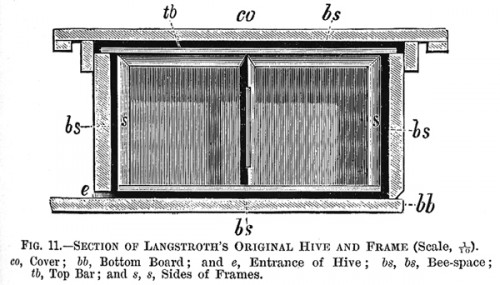
Lorenzo Langstroth’s moveable frame hive incorporated "bee space," a 3/8-inch space that the bees use to navigate around the hive. The space enabled beekeepers to easily remove each honeycomb-laden frame and extract the honey with minimal damage to the comb or to the bees.
CHAMPAIGN, lll. In 1851, Lorenzo Langstroth, a Congregational minister and young ladies' school principal based in Philadelphia, revolutionized the practice of beekeeping. He had observed that honey bees will fill a large space in their hives with honeycomb and seal small cracks with propolis, a resinous "bee glue" made from tree sap and other sticky substances, but will leave any gap that is about 3/8 of an inch wide - just big enough for a bee to pass through. Langstroth was the first to incorporate this "bee space," which allows bees to navigate through the hive, into the design of his box-frame hive. Building on other innovations of his day - the use of frames or slats to support the weight of honeycombs in the hive, for example - Langstroth devised the first "moveable frame hive," in which each comb-filled frame had a 3/8-inch space around it. This allowed beekeepers to extract the honey - frame by frame - without killing their most productive bees or destroying their combs, as other methods had done. His design made better use of the space inside the hive and increased the yield of a typical hive from about 20 pounds to more than 100 pounds per year.
TO READ THIS ARTICLE, CREATE YOUR ACCOUNT
And extend your reading, free of charge and with no commitment.