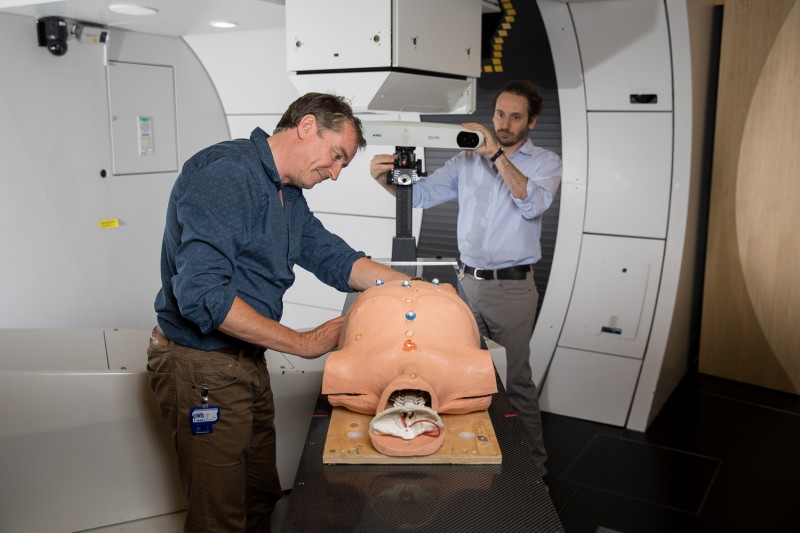
The medical physicists Antony Lomax and Giovanni Fattori examine the phantom Luca, evaluating procedures for the optimum irradiation of moving tumours with protons. Luca is based on the form of a human torso. Breathing movements are simulated with the help of a pump. Its interior is full of measuring devices and markers are attached to its surface, enabling researchers to monitor breathing movements during a radiation session via video camera. (Photo: Paul Scherrer Institute/Mahir Dzambegovic)
Radiation therapy using protons is a success story at the Paul Scherrer Institute PSI. For several decades now, doctors have been administering a gentle form of radiation treatment to patients with ocular tumours or those located deep inside the body. Elaborate research carried out at the Centre for Proton Therapy has led to the development of numerous devices, safety systems and software. A radiation method developed by PSI researchers has even resulted in lasting changes in proton therapy worldwide. Despite these successes, researchers at CPT continue tirelessly to refine proton radiation therapy in order to make treatment even faster and more precise in the future. Antony Lomax really only wanted to stay for two years, carry out intensive research and then return—home to Manchester. But protons exert a special kind of fascination.
TO READ THIS ARTICLE, CREATE YOUR ACCOUNT
And extend your reading, free of charge and with no commitment.