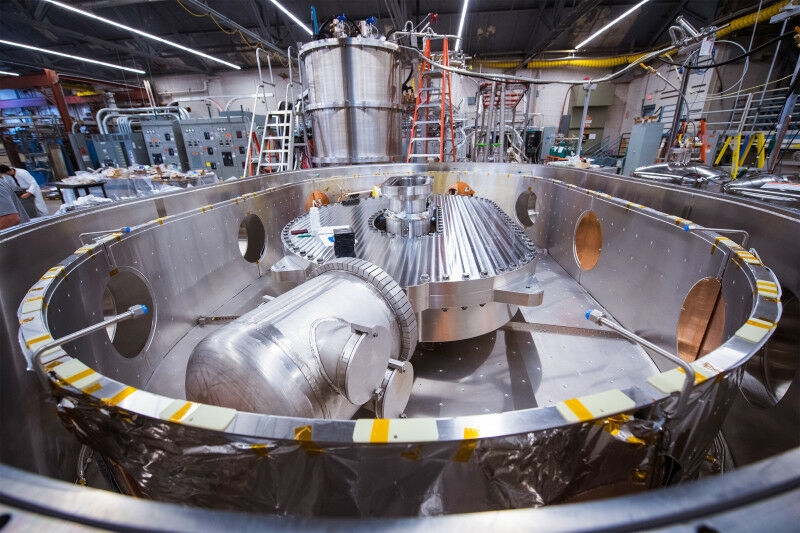
In MIT’s Plasma Science and Fusion Center, the new magnets achieved a world-record magnetic field strength of 20 tesla for a large-scale magnet. Credits : Image: Gretchen Ertl
In MIT's Plasma Science and Fusion Center, the new magnets achieved a world-record magnetic field strength of 20 tesla for a large-scale magnet. Credits : Image: Gretchen Ertl Detailed study of magnets built by MIT and Commonwealth Fusion Systems confirms they meet requirements for an economic, compact fusion power plant. In the predawn hours of Sept. 5, 2021, engineers achieved a major milestone in the labs of MIT's Plasma Science and Fusion Center (PSFC), when a new type of magnet, made from high-temperature superconducting material, achieved a world-record magnetic field strength of 20 tesla for a large-scale magnet. That's the intensity needed to build a fusion power plant that is expected to produce a net output of power and potentially usher in an era of virtually limitless power production. The test was immediately declared a success, having met all the criteria established for the design of the new fusion device, dubbed SPARC, for which the magnets are the key enabling technology. Champagne corks popped as the weary team of experimenters, who had labored long and hard to make the achievement possible, celebrated their accomplishment.
TO READ THIS ARTICLE, CREATE YOUR ACCOUNT
And extend your reading, free of charge and with no commitment.