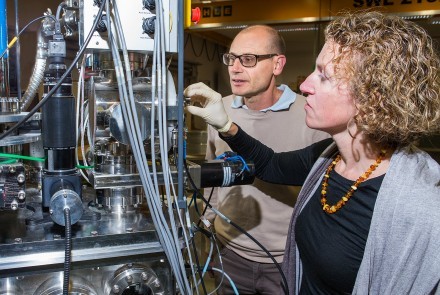
Joerg Hermann (L) and Daniela Rubatto in the Research School of Earth Sciences
Scientists have found evidence for a huge mountain range that sustained an explosion of life on Earth 600 million years ago. The mountain range was similar in scale to the Himalayas and spanned at least 2,500 kilometres of modern west Africa and northeast Brazil, which at that time were part of the supercontinent Gondwana. "Just like the Himalayas, this range was eroded intensely because it was so huge. As the sediments washed into the oceans they provided the perfect nutrients for life to flourish," said Professor Daniela Rubatto of the Research School of Earth Sciences at The Australian National University (ANU). "Scientists have speculated that such a large mountain range must have been feeding the oceans because of the way life thrived and ocean chemistry changed at this time, and finally we have found it." The discovery is earliest evidence of Himalayan-scale mountains on Earth. "Although the mountains have long since washed away, rocks from their roots told the story of the ancient mountain range's grandeur," said co-researcher Professor Joerg Hermann. "The range was formed by two continents colliding.
TO READ THIS ARTICLE, CREATE YOUR ACCOUNT
And extend your reading, free of charge and with no commitment.