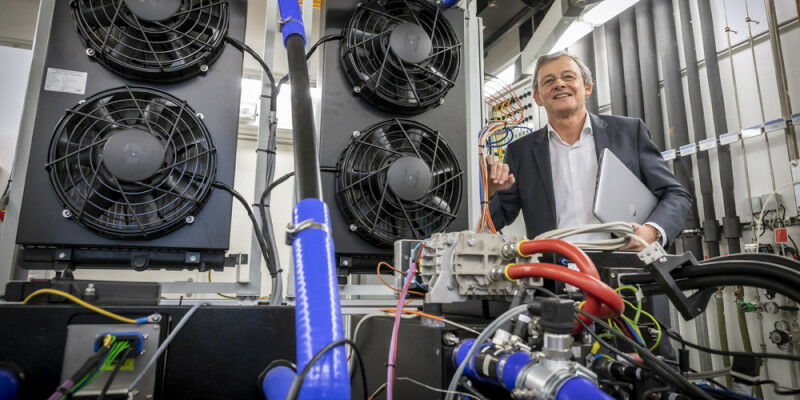
 Environmentally friendly mobility is close to Helmut Eichelseder’s heart.
Environmentally friendly mobility is close to Helmut Eichelseder's heart. Lunghammer - TU Graz - By Birgit Baustädter Fossil combustion engines are generally considered to be less environmentally friendly, as they are responsible for a large proportion of transport-related CO2 emissions. Helmut Eichlseder, explains why the internal combustion engine cannot be missing from the sustainable mobility mix. "Internal combustion engines have been more or less written off in the court of public opinion," explains Helmut Eichlseder , casually crossing his legs as he sits at the head of his conference table in Inffeldgasse in Graz. His office is on the third floor of a gleaming white new building in the middle of Campus Inffeldgasse - three floors above the engine test benches for which the Institute of Internal Combustion Engines and Thermodynamics is known, among other things. The man with the brown-grey waves of hair has now been head of the Institute for 20 years and has decisively pushed the Institute's path towards sustainable mobility. Today, researchers are primarily concerned with sustainable forms of mobility, conducting research on fuel cells as vehicle propulsion, hydrogen as fuel in combustion engines and e-fuels as an alternative in conventional engines.
TO READ THIS ARTICLE, CREATE YOUR ACCOUNT
And extend your reading, free of charge and with no commitment.
Your Benefits
- Access to all content
- Receive newsmails for news and jobs
- Post ads