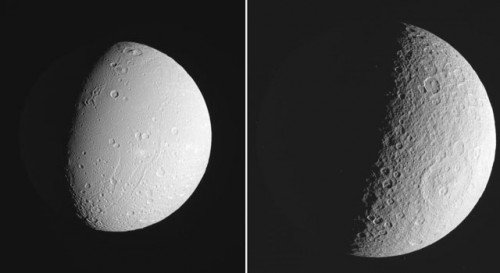
These three views of Saturn’s moon Rhea were made from data obtained by NASA’s Cassini spacecraft. Image credit: NASA/JPL/SSI/LPI
October 19, 2010 Taking a long-weekend road trip, NASA's Cassini spacecraft successfully glided near nine Saturnian moons, sending back a stream of raw images as mementos of its adrenaline-fueled expedition. The spacecraft sent back particularly intriguing images of the moons Dione and Rhea. The Dione and Rhea pictures are the highest-resolution views yet of parts of their surfaces. The views of the southern part of Dione's leading hemisphere (the part of the moon that faces forward in its orbit around Saturn) and the equatorial region of Rhea's leading hemisphere are more detailed than the last time we saw these terrains with NASA's Voyager spacecraft in the early 1980s. Of the five big icy moons of Saturn, Dione and Rhea are often considered a pair because they orbit close to each other, are darker than the others, and exhibit similar patterns of light reflecting off them. These new images, however, highlight the differences between these sister moons. Both images show similar geographic regions on each satellite.
TO READ THIS ARTICLE, CREATE YOUR ACCOUNT
And extend your reading, free of charge and with no commitment.