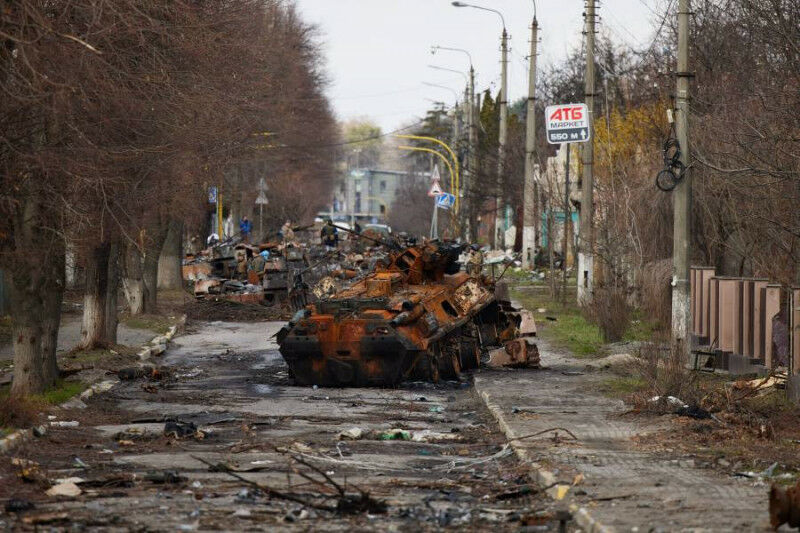
A destroyed tank and debris litters streets in Bucha after the Russian invasion of Ukraine
A destroyed tank and debris litters streets in Bucha after the Russian invasion of Ukraine - The prolonged violence is shaking up global political alliances, driving food insecurity, and upending the lives of millions of refugees, Johns Hopkins experts said during a live briefing May 17 The geopolitical impacts of Russia's war on Ukraine rippled further this week, with Sweden and Finland's requests to join NATO-potentially breaking decades of neutrality for those countries and adding a complex new layer to Europe's political and defense landscape. "This is a hugely significant development, and it simply would not be happening if Putin had not invaded Ukraine," said Mary Elise Sarotte , an international relations historian at the Johns Hopkins School of Advanced International Studies , during a virtual event Tuesday. "It's significant politically, it's hugely significant militarily, and it's significant in terms of the message it sends." For one, the Baltic states would have better protection against potential Russian aggression, Sarotte said. "As you add Finland and Sweden, suddenly you turn the Baltic Sea into a NATO lake. The Baltics start to look like defensible territory." Meanwhile, "the European pillar of NATO" appears to be strengthening independently of the United States, according to European Union expert Nicolas Jabko , an associate professor of political science in the Krieger School. "EU leaders are now coming up with new initiatives for beefing up the European foreign policy and defense dimension," he said.
TO READ THIS ARTICLE, CREATE YOUR ACCOUNT
And extend your reading, free of charge and with no commitment.