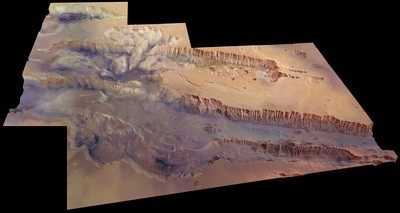
Valles Marineris
Earth's Grand Canyon inspires awe for anyone who casts eyes upon the vast river-cut valley, but it would seem nothing more than a scratch next to the cavernous scar of Valles Marineris that marks the face of Mars. Stretching over 4000 km long and 200 km wide, and with a dizzying depth of 10 km, it is some ten times longer and five times deeper than Earth's Grand Canyon, a size that earns it the status of the largest canyon in the Solar System. Seen here in new light and online for the first time, this bird's-eye view of Valles Marineris was created from data captured during 20 individual orbits of ESA's Mars Express. It is presented in near-true colour and with four times vertical exaggeration. A wide variety of geological features can be seen, reflecting the complex geological history of the region. The canyon's formation is likely intimately linked with the formation of the neighbouring Tharsis bulge, which is out of shot and to the left of this image and home to the largest volcano in the Solar System, Olympus Mons. The volcanic activity is revealed by the nature of the rocks in the walls of the canyon and the surrounding plains, which were built by successive lava flows.
TO READ THIS ARTICLE, CREATE YOUR ACCOUNT
And extend your reading, free of charge and with no commitment.