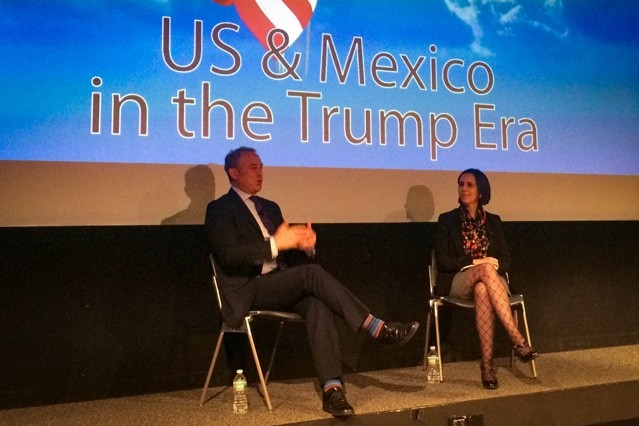
Ambassador Arturo Sarukhan (left), former Mexican Ambassador to the US (2007-2013), and Lourdes Melgar, CIS Wilhelm Fellow and Mexico’s former Deputy Secretary of Energy for hydrocarbons.
Over the past two years, U.S.-Mexico relations have taken a distinctive turn, largely stemming from the issue agenda President Donald Trump has brought to U.S. politics: Trump campaigned on building a border wall, perhaps to be paid for by Mexico, and says he wants to change the North American Free Trade Agreement (NAFTA), which shapes the countries' economic relations. The wall may not reach fruition, and it's unclear whether NAFTA will be significantly altered, but these political stances have created a 'fundamental tectonic shift in the relationship' between the U.S. and Mexico, observed Arturo Sarukhan, former Mexican ambassador to the U.S., at a public forum at MIT on Friday. To find the last time the U.S. and Mexico were this far out of alignment, Sarukhan suggested, one has to go back to the Cold War, when the U.S. emphasized intervention in Central America as part of its policy of containment, and found itself and Mexico on opposite sides of multiple political struggles. 'Not since this moment in the late 1980s has this relationship been this acrimonious,' Sarukhan told the audience of about 150 in MIT's Bartos Theater. And yet, the two countries conduct about $1.4 billion in trade every day, with about 6 million U.S. jobs depending on trade across the border, as Sarukhan noted. So that presents a vital question: How can the two countries move their relationship forward? From tension, a path forward For Sarukhan, the answer lies partly in an adage he attributed to Chicago Mayor Rahm Emmanuel: 'You shouldn't let a crisis go to waste.' That is, when pressure for change occurs, it may actually present an opportunity to make needed policy revisions.
TO READ THIS ARTICLE, CREATE YOUR ACCOUNT
And extend your reading, free of charge and with no commitment.