The meltwater pulse produced by the saddle-collapse can explain more than half of the sea level jump observed around 14,600 years ago. The rest probably came from the progressive melting of ice sheets in Europe and Antarctica.
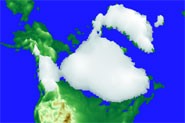
The cause of rapid sea level rise in the past has been found by scientists at the University of Bristol using climate and ice sheet models. The process, named 'saddle-collapse', was found to be the cause of two rapid sea level rise events: the Meltwater pulse 1a (MWP1a) around 14,600 years ago and the '8,200 year' event. Using a climate model, Lauren Gregoire of Bristol's School of Geographical Sciences and colleagues unearthed the series of events that led to saddle-collapse in which domes of ice over North America became separated, leading to rapid melting and the opening of an ice free corridor. Evidence of these events has been recorded in ocean cores and fossil coral reefs; however, to date the reason behind the events was unclear and widely debated. Ice domes up to 3 km thick (three times the height of Snowdon), formed in regions of high snowfall and higher topography, such as the Rocky Mountains. Together with the saddles - lower valleys of ice between the domes - these made up the ice sheet. Towards the end of the last ice age, at the time of mammoths and primitive humans, the climate naturally warmed.
TO READ THIS ARTICLE, CREATE YOUR ACCOUNT
And extend your reading, free of charge and with no commitment.