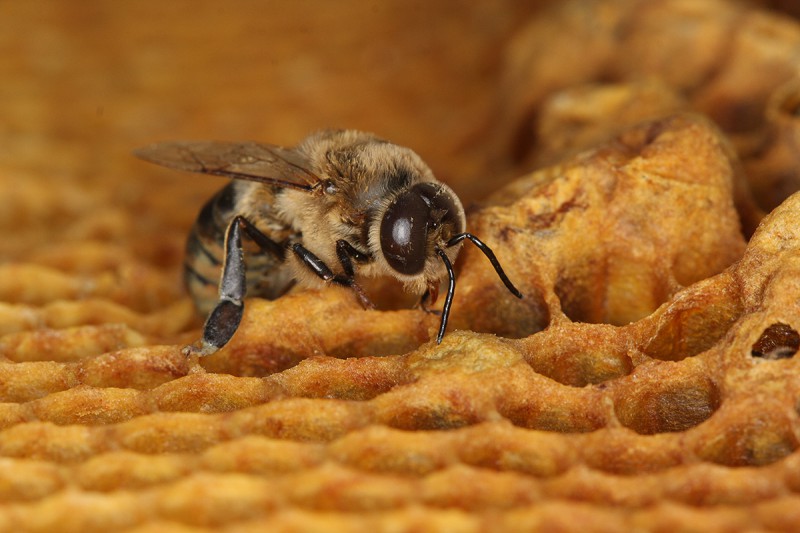
 A newly emerged male honey bee, known as a drone, on a wax bee frame.
Male honey bees, called drones, can be affected by two neonicotinoid insecticides by reducing male honey bee lifespan and number of living sperm. Both insecticides are currently partially banned in Europe. Researchers from Bern, Switzerland, together with partners from Thailand and Germany, call for more thorough environmental risk assessments of these neonicotinoids. In recent years, beekeepers have struggled to maintain healthy honey bee colonies throughout the northern hemisphere. In the first study to investigate the effects of neonicotinoids on drones, and one of the first to study the effects of these agricultural chemicals on males in general, an international research team led by the University of Bern and Agroscope has found that two neonicotinoids may inadvertently reduce drone lifespan and number of living sperm. Because queen survival and queen productivity are intimately connected to successful mating with males, any influence on sperm quality may have profound consequences for the health of the queen, as well as the entire colony. In light of recent beekeeper surveys that identified poor queen health as an important reason for honey bee colony losses, this study further strengthens calls for more thorough environmental risk assessments of these insecticides, as well as other crop protection products, to protect bees and other beneficial organisms.
TO READ THIS ARTICLE, CREATE YOUR ACCOUNT
And extend your reading, free of charge and with no commitment.
Your Benefits
- Access to all content
- Receive newsmails for news and jobs
- Post ads


