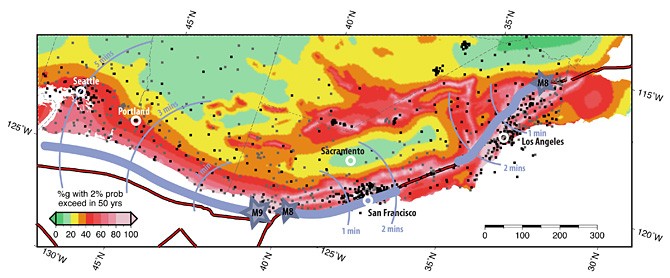
A map of earthquake hazards in California, red being most vulnerable, showing the minutes of early warning possible in urban areas after large quakes at various places along the state’s faultlines (red). Image by Richard Allen, UC Berkeley.
Although California Gov. Jerry Brown signed a bill last week to create a statewide earthquake early warning system, the United States is still behind the curve in embracing technology that has proven to save lives, lessen damage and speed recovery after a major quake. Richard Allen, director of the Berkeley Seismological Laboratory, makes this argument in a commentary in this week's issue of the journal Nature . And he says it's time to institute an early warning system in this country, "rather than waiting until the next big quake galvanizes political action” because of loss of life and property. Simulated earthquake early warning generated by the ShakeAlert system for a repeat of the 1989 Loma Prieta M6.9 earthquake. Video shows the warning that would be received in Berkeley using the current demonstration system being tested by UC Berkeley, Caltech, the US Geological Survey and other partners. Gov.
TO READ THIS ARTICLE, CREATE YOUR ACCOUNT
And extend your reading, free of charge and with no commitment.