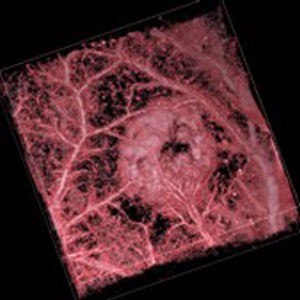
Photoacoustic image of SW1222 colorectal tumour xenograft
Researchers from UCL Medical Physics & Bioengineering and the UCL Cancer Institute have won an award for a paper on a pioneering medical imaging instrument that they have developed. Dr Edward Zhang, Jan Laufer, Professor Barbara Pedley and Professor Paul Beard won the 2009 Roberts Prize for the best paper published in Physics in Medicine & Biology last year for their paper on photoacoustic tomography. The paper describes a new type of biomedical imaging instrument that exploits the photoacoustic effect - a phenomenon in which the absorption of short laser pulses by haemoglobin can be exploited to produce high-resolution 3D images of blood vessel networks. The instrument is based upon an optical ultrasound sensor that was invented at UCL. It represents a completely new approach to the implementation of photoacoustic imaging, offering improved sensitivity and resolution over conventional methods. The study reported in the paper demonstrates that the scanner can provide 3D images of networks of blood vessels in the skin and a tumour model to depths of approximately 5mm with sub-100 micrometre spatial resolution (below a tenth of a millimetre). The concept offers the prospect of providing a range of improved imaging tools for studying soft tissue abnormalities characterised by changes in the structure, oxygenation and flow status of blood vessels.
TO READ THIS ARTICLE, CREATE YOUR ACCOUNT
And extend your reading, free of charge and with no commitment.