Mark Vorreuter
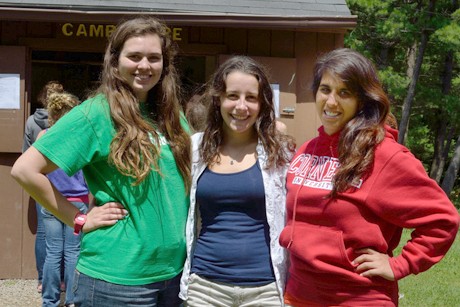
Summer camp is often about archery, swimming and singing around the fire. But this past summer, Natasha Herrick '15, Leticia Vasquez '15 and Meredith Moser '15 were in for a different kind of camp adventure - their first academic research study. Working with Jane Mendle, assistant professor of human development in the College of Human Ecology, the three served as research assistants for a pilot study to test expressive writing interventions with adolescent girls at 4-H Camp Bristol Hills in Canandaigua, N.Y. The project, funded partly by Cornell's Bronfenbrenner Center for Translational Research, formed when Tim Davis, 4-H youth development program leader with Cornell Cooperative Extension (CCE) of Ontario County, discussed possible collaborations at the residential summer camp with Mendle. "Everybody knows that puberty is rough on kids, as relationships with parents and peers are changing," Mendle said. "Our lab, like a lot of others interested in puberty, tends to focus on the consequences of puberty - which can include depression, anxiety, externalizing or 'acting out' behaviors, poor self-esteem and body dissatisfaction. In this project we wanted to explore what happens if we intervene before teens get to that point." Mendle's research assistants lived at Bristol Hills and used free slushies to recruit 45 girls, ages 11 to 13. (Boys will be included in a future study.
TO READ THIS ARTICLE, CREATE YOUR ACCOUNT
And extend your reading, free of charge and with no commitment.