Undoped silicon makes simpler, cheaper but efficient solar cells
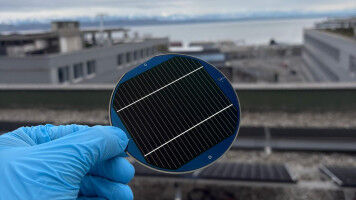
27. A group of international researchers led by Berkeley scientists create a high-efficiency silicon device in seven steps. The core part of the prototypes have been built at EPFL's Photovoltaics Lab, led by Christophe Ballif, in Neuchâtel. Researchers have simplified the steps to create silicon solar cells that convert sunlight to electricity with high efficiency by applying a new mix of materials to a standard design. Published this week in Nature Energy , the work is a result of a collaboration between the Lawrence Berkeley National Laboratory (Berkeley Lab), EPFL, and the Australian National University (ANU). The special blend of materials - that could also prove useful in semiconductor components - eliminates the need for a process called "doping", which steers the device's semiconductor properties by introducing foreign atoms, but also makes the device's processing more complicated and causes losses in performance. "The solar-cell industry is driven by the need to reduce costs and increase performance," says James Bullock, the lead author of the study.