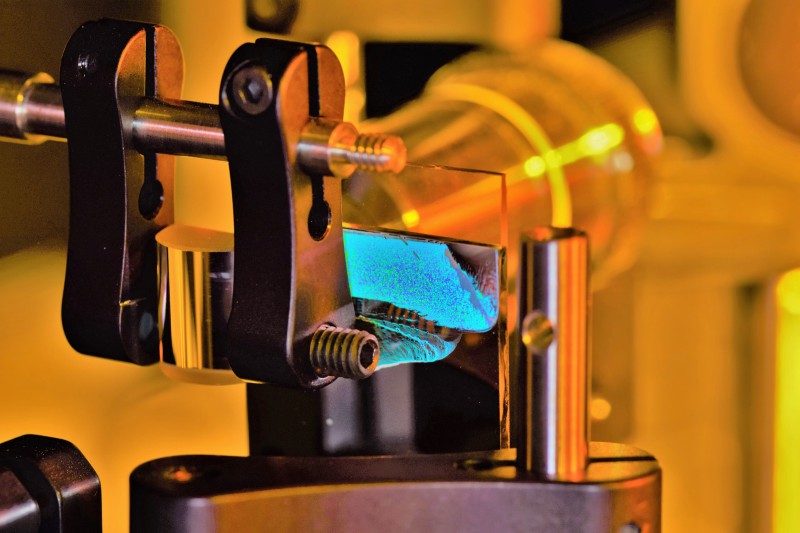
The microscale granular crystal in the laser ultrasonic experimental setup. The vibrant colors in the crystal are due to optical diffraction. University of Washington
UW engineers for the first time have analyzed interactions between microscale granular crystals - which include up-and-down, horizontal, and rotational motion. Read more scientific details here. (GIF credit: Samuel Wallen/University of Washington) - Designing materials that better respond to dynamic loading can help vehicles minimize vibration, better protect military convoys or potentially make buildings safer during an earthquake. Granular materials - assemblages of particles that range broadly from powders to sand to microscopic beads of glass - are one of the least understood forms of matter due to the incredibly complex ways that those particles interact. But those complicated physics also offer tantalizing potential to create materials with unique properties - like the ability to absorb impact energy in customized ways. In a paper published May 13 in Physical Review Letters , University of Washington mechanical engineers have for the first time observed and analyzed collective interparticle vibrations in two-dimensional microscale granular crystals - a type of designer granular material. This understanding and ability to predict how these tiny arrays of particles behave as forces are applied is a first step in creating novel materials that could be used for everything from impact mitigation to signal processing, disease diagnosis, or even making more controllable solid rocket propellants.
TO READ THIS ARTICLE, CREATE YOUR ACCOUNT
And extend your reading, free of charge and with no commitment.