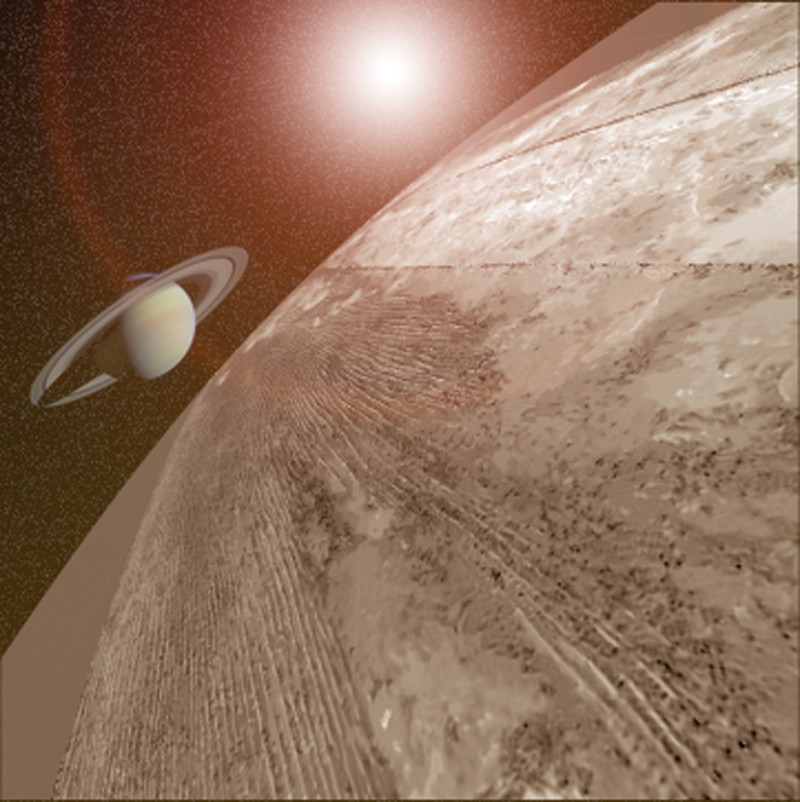
A view of Titan. Saturn’s largest moon, with its ringed host in the background. New research from the University of Washington may solve a riddle of the direction of sand dunes on the moon’s surface. Antoine Lucas
With its thick, hazy atmosphere and surface rivers, mountains, lakes and dunes, Titan , Saturn's largest moon, is one of the most Earthlike places in the solar system. As the Cassini-Huygens spacecraft examines Titan over many years, its discoveries bring new mysteries. One of those involves the seemingly wind-created sand dunes spotted by Cassini near the moon's equator, and the contrary winds just above. Here's the problem: Climate simulations indicate that Titan's near-surface winds - like Earth's trade winds - blow toward the west. So why do the surface dunes, reaching a hundred yards high and many miles long, point to the east? The direction of the dunes has at times been attributed to the effects of Saturn's gravitational tides or various land features or wind dynamics, but none quite explained their eastward slant. Violent methane storms high in Titan's dense atmosphere, where winds do blow toward the east, might be the answer, according to new research by University of Washington astronomer Benjamin Charnay and co-authors in a paper published today Geoscience. Using computer models, Charnay, a UW post-doctoral researcher, and co-authors hypothesize that the attitude of Titan's sand dunes results from rare methane storms that produce eastward gusts much stronger than the usual westward surface winds.
TO READ THIS ARTICLE, CREATE YOUR ACCOUNT
And extend your reading, free of charge and with no commitment.