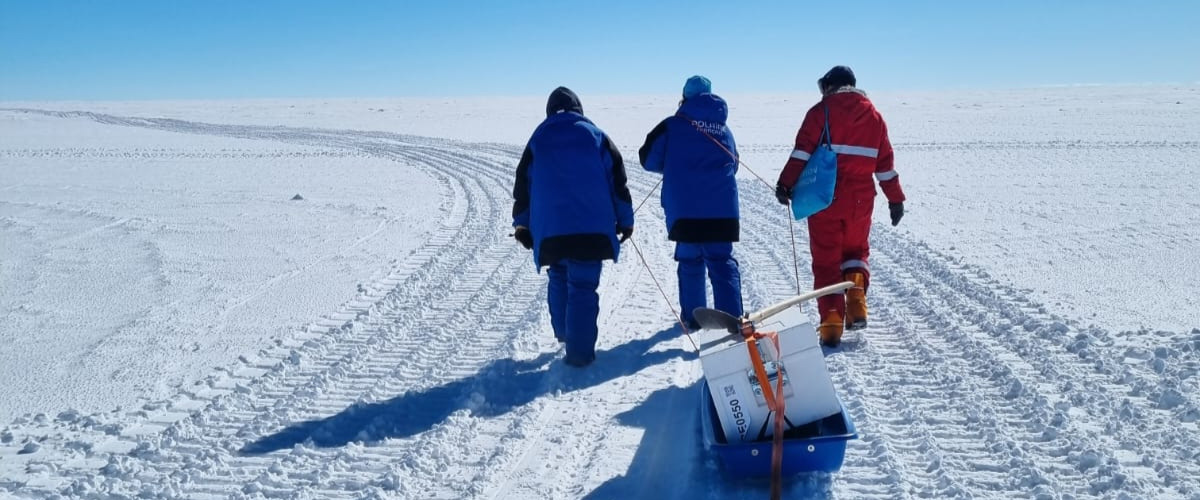
40 kilometers from Concordia Station, at the Little Dome C drilling site, some 15 scientists have been taking turns every year since 2019 on an extraordinary mission: to reconstruct the Earth’s climate variations over 1.5 million years. Last winter, the team achieved a historic feat by extracting a 2,800-metre-long ice core 1.2 million years old - a world first. A veritable time capsule, the air bubbles trapped in the ice provide a unique record of climate evolution, enabling us to anticipate future changes.
In the middle of this white desert, between extreme temperatures, thousand-year-old ice-cuts, curious penguins and a refrigerated laboratory at -35°C, Lisa Ardoin , a doctoral student at the Faculty of Science’s Glaciology Laboratory, not only worked, but also filmed her daily life. GoPro camera in hand, she captured images of science and life, which she now shares in a series of 10 vlogs published twice a week on her Instagram account @l_lardoin.
Beyond the lab
Highly committed to scientific outreach, Lisa has launched a host of initiatives to make her work more accessible, including the Ma thèse en 180 secondes (My thesis in 180 seconds) competition, educational videos for the European DEEPICE project, and popularization events for children. All these initiatives have earned her the ULB 2024 Science Diffusion Prize - doctoral student category. Her aim: to break down the over-serious image of research, pass on her passion and motivate people to take action in the face of the climate challenge.Her vlogs offer a rare opportunity to go behind the scenes of an exceptional scientific mission to the heart of the white continent.