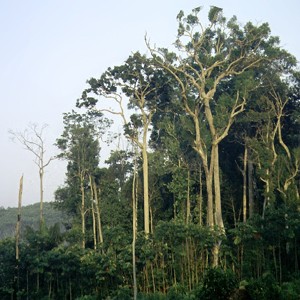
A small fragment of mature Amazon forest surrounded by agricultural land in Manaus, Brazil.by Christopher Dick, University of Michigan.
New genetic analysis has revealed that many Amazon tree species are likely to survive man-made climate warming in the coming century, contrary to previous findings that temperature increases would cause them to die out. A study, published in the latest edition of Ecology and Evolution, reveals the surprising age of some Amazonian tree species - more than 8 million years - and therefore shows that they have survived previous periods as warm as many of the global warming scenarios forecast for the year 2100. The authors write that, having survived warm periods in the past, the trees will likely survive future warming, provided there are no other major environmental changes. Although extreme droughts and forest fires will impact Amazonia as temperatures rise, the trees will likely endure the direct impact of higher temperatures. The authors recommend that as well as reducing greenhouse gas emissions to minimise the risk of drought and fire, conservation policy should remain focused on preventing deforestation for agriculture and mining. The study is at odds with other recent research, based on ecological niche-modeling scenarios, which predicted tree species' extinctions in response to relatively small increases in global average air temperatures. Study co-author Simon Lewis (UCL Geography) said the findings were good news for Amazon tree species, but warned that drought and over-exploitation of the forest remained major threats to the Amazon's future.
TO READ THIS ARTICLE, CREATE YOUR ACCOUNT
And extend your reading, free of charge and with no commitment.