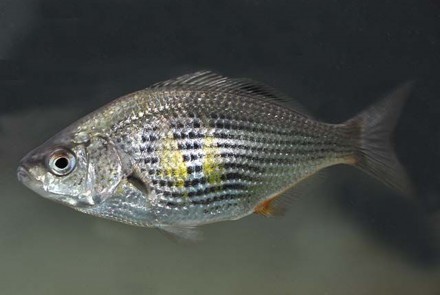
Shiner surfperch, Cymatogaster aggregate, the study species. Photo credit: Kevin Lee
Big waves are energetically costly for fish, and there are more big waves than ever. The good news is that fish might be able to adapt. "There has been a lot of recent work in oceanography documenting the fact that waves are becoming more frequent and more intense due to climate change," says Mr Dominique Roche, PhD candidate from the Research School of Biology. "The habitats that fish live in are changing." "This is not a localised problem, but something that is documented globally," adds Ms Sandra Binning, also a PhD candidate in the Research School of Biology. Mr Roche and Ms Binning are co-authors on a study documenting the energy it takes for fish to swim through large, intense waves. Specifically, they focused on fish that swim with their arm, or pectoral fins, which are very common on both rocky and coral reefs. "By controlling water flow in an experimental chamber with the help of a computer, we were able to replicate oscillations in the water flow like in a wave pool," explains Mr Roche.
TO READ THIS ARTICLE, CREATE YOUR ACCOUNT
And extend your reading, free of charge and with no commitment.