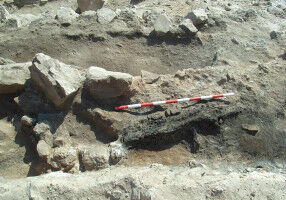
A local motor of Greek religion: the Sanctuary of Poseidon on the island of Poros in the Saronic Gulf marked a neuralgic point in the dense network of religious activity in ancient Greece.
A local motor of Greek religion: the Sanctuary of Poseidon on the island of Poros in the Saronic Gulf marked a neuralgic point in the dense network of religious activity in ancient Greece. WWU - Hans Beck In his book "Localism and the Ancient Greek City-State", Prof. Hans Beck from the Department of Ancient History traces the influence of localism in the globalized world of ancient Greece. He provides detailed insights into local everyday worlds from the eighth to the first centuries BCE. An analysis of things happening locally can flesh out our historical understanding of this era. The ancient historian also shows how his studies can be incorporated into current discussions on globalisation. Kathrin Nolte spoke to Hans Beck on his findings and his interdisciplinary approach. Why is the contrast between the global and the local in ancient Greece so important? When we talk about the Greek world between about 800 and 100 BCE, we often picture a homogeneous historical and cultural area. When we take a closer look, however, we see that this is not the case. The reason is that Greek history was determined by many individual towns and cities - sometimes just small village communities. Using the so-called network paradigm, there have been attempts recently to describe the ancient Greek world more precisely. What is decisive for our understanding is the interplay between the widespread networking seen in Greek culture on the one hand, and its tradition as lived out locally on the other. Greek culture in the ancient world always means multiplicity and local divergence. As a scholar of antiquity, you draw up detailed case studies which illuminate local events in ancient Greece, is that right?
TO READ THIS ARTICLE, CREATE YOUR ACCOUNT
And extend your reading, free of charge and with no commitment.
Your Benefits
- Access to all content
- Receive newsmails for news and jobs
- Post ads