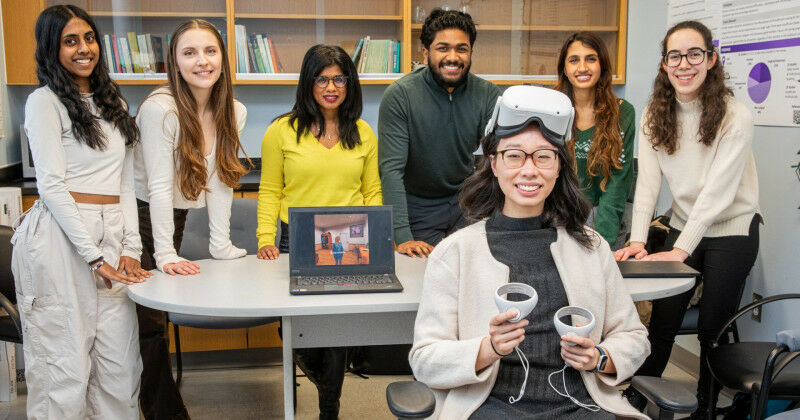
Researchers from the Caregiving Research Laboratory, (L-R) Abirami Mathiyalagan, Grace Norris, Marie Savundranayagam, George Philip, Anya Sarma and Grace Malheiro, gather behind Allison Chen as she shows off the Be EPIC virtual reality tool. (Christopher Kindratsky/Western Communications photo)
Researchers from the Caregiving Research Laboratory, (L-R) Abirami Mathiyalagan, Grace Norris, Marie Savundranayagam, George Philip, Anya Sarma and Grace Malheiro, gather behind Allison Chen as she shows off the Be EPIC virtual reality tool. (Christopher Kindratsky/Western Communications photo) "Hello James. My name is Allison. How are you doing today?" Speech-language pathologist Allison Chen sits in an office chair, facing a blank wall. She's in a virtual reality headset, practicing how to communicate with a person living with dementia. Chen is modeling an innovative system designed for personal support workers and other frontline caregivers. The virtual reality (VR) training - delivered through a headset - gives real-time feedback on health-care professionals' communication after they interact with one of two avatars, James or Nala, both showing signs of moderate-stage Alzheimer's disease.
TO READ THIS ARTICLE, CREATE YOUR ACCOUNT
And extend your reading, free of charge and with no commitment.