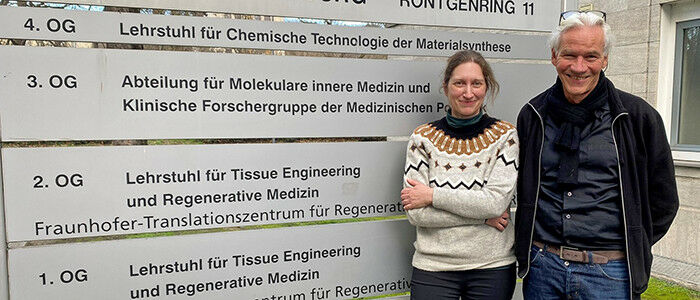
Sarah Nietzer and Associate Oliver Pullig are responsible for both projects at the Department of Tissue Engineering and Regenerative Medicine, in which the production of autologous cartilage tissue from the nose is to be established for the regeneration of cartilage defects in the knee. (Image: Kirstin Linkamp / Universitätsklinikum Würzburg)
Sarah Nietzer and Associate Oliver Pullig are responsible for both projects at the Department of Tissue Engineering and Regenerative Medicine, in which the production of autologous cartilage tissue from the nose is to be established for the regeneration of cartilage defects in the knee. (Image: Kirstin Linkamp / Universitätsklinikum Würzburg) Treating knee joint defects with cartilage from the nose: The University Hospital in Würzburg is working on the approval of this procedure. They received funding of 2.3 million euros for this purpose. Even though the recently launched EU project ENCANTO ("magic" in Spanish) has nothing to do with the Disney movie of the same name, the study topic might sound like magic to the layman. "We take a small piece of cartilage from the nasal septum of our patients, culture it on a structurally supportive collagen matrix, and implant it four weeks later into the damaged knee to regenerate the cartilage," Dr. Oliver Pullig explains. The safety and efficacy of this method for cartilage regeneration has already been demonstrated by the biologist in a former nasal cartilage study with an international team under the direction of the University Hospital Basel on more than 100 individuals. In this study, focal cartilage lesions, i.e., locally limited, and clearly defined injuries, which occur for example, after an accident, were treated with the laboratory grown cartilage tissue from the nose.
TO READ THIS ARTICLE, CREATE YOUR ACCOUNT
And extend your reading, free of charge and with no commitment.