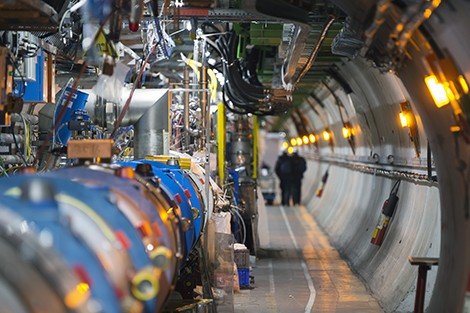
 © Cyril Fresillon/LHC/CNRS Photothèque LHC Tunnel (Large Hadron Collider), a particle accelerator at the French-Swiss border. It is the world’s most powerful particle accelerator.
A new site opened on Friday, June 15, 2018, at the LHC, the Large Hadron Collider. Begun in 2011, this project aims to commission a high-luminosity LHC (HL-LHC) by 2026 that will increase the number of proton-proton collisions and gather more data. France is contributing substantially to this project (to the tune of 180 million euros, including salaries). Teams at CNRS and CEA are participating in technological research and development specifically on superconducting magnets and on extending the lifespan of detectors and the accelerator. In France more than 400 scientists are involved with this renewal of the world's largest and most powerful particle collider. The LHC – Large Hadron Collider - was first brought into service in 2008. It is a ring with a 27-kilometer circumference equipped with thousands of superconducting magnets that hold accelerated particles inside the ring.
TO READ THIS ARTICLE, CREATE YOUR ACCOUNT
And extend your reading, free of charge and with no commitment.
Your Benefits
- Access to all content
- Receive newsmails for news and jobs
- Post ads