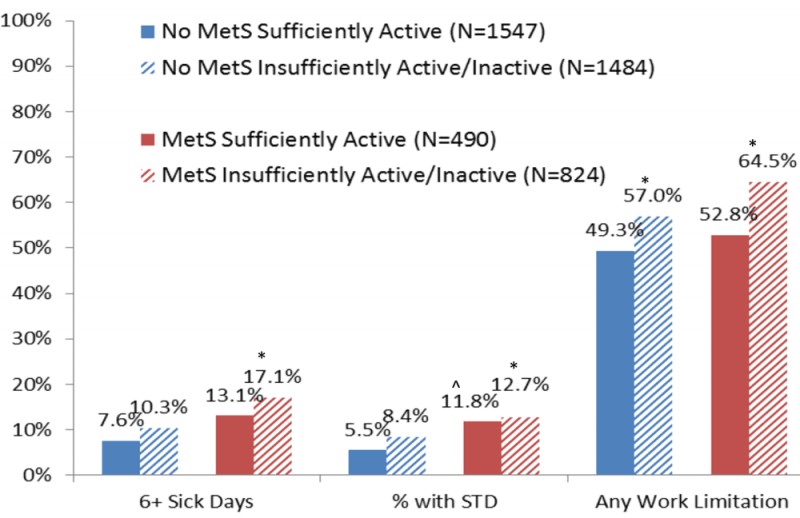
Productivity measures in employees with and without MetS and with and without sufficient physical activity. N=435. *p<.05 generalized linear model testing difference between insufficiently active/inactive with sufficiently active within MetS category, adjusting for age, gender, ethnicity, geographic location and job type. ^ p<.05 generalized linear model testing difference between "MetS sufficiently active" with "No MetS insufficiently active/inactive", adjusting for age, gender, ethnicity, geographic location and job type.
ANN ARBOR-Get moving: just 20 minutes of exercise a day dramatically lowers the risk of diabetes and heart disease, even for employees with a high risk of developing those conditions. A University of Michigan study looked at the impact of exercise on 4,345 employees in a financial services company that had just started a workplace wellness program. Roughly 30 percent of employees were high risk and suffering from metabolic syndrome, a dangerous cluster of risk factors associated with diabetes and heart disease. Overall, about 34 percent of U.S. adults have metabolic syndrome. The study found that when the high-risk employees accumulated the government-recommended 150 minutes of moderate-intensity exercise a week, their health care costs and productivity equaled that of healthy employees who didn't exercise enough, said Alyssa Schultz, a researcher at the Health Management Research Center in the U-M School of Kinesiology. "It was a real surprise, the level of protection physical activity gave to people with metabolic syndrome," Schultz said. "We can't control our family history and some health indicators such as cholesterol can be difficult to manage, but if individuals get enough exercise, the negative impacts of metabolic syndrome could be mitigated." This is also good news for companies trying to cut health care costs, Schultz said.
TO READ THIS ARTICLE, CREATE YOUR ACCOUNT
And extend your reading, free of charge and with no commitment.