At a time when the world’s glaciers are melting at an unprecedented rate, tourism around these ice giants is exploding, increasing pressure on these vulnerable regions and disrupting ecosystems. A study carried out by the University of Lausanne provides insights into how to reconcile tourism, preservation, awareness-raising and social justice.
Since the 18th century, glaciers have fascinated mountaineers, scientists and nature lovers alike. In recent years, however, this tourist attraction has been multiplied by the media coverage of their agony, linked to climate change. More than 14 million people, torn between fascination, scientific curiosity and ecological mourning, visit the sites of the best-known glaciers every year, generating substantial income for some sectors, but paradoxically increasing the pressure on already fragile areas.
Global specialists in glacier tourism issues, including Emmanuel Salim, Associate Researcher at the Institute of Geography and Sustainability at the University of Lausanne, have written a new perspective article in Nature Climate Change, which takes stock of the tourism and cultural dynamics observable around glaciers. It suggests avenues of research to prevent maladaptation strategies from spreading. In other words, tourism and government responses that, instead of raising awareness and reducing vulnerability, actually worsen the situation for local populations and ecosystems.
The problem of last-chance tourism
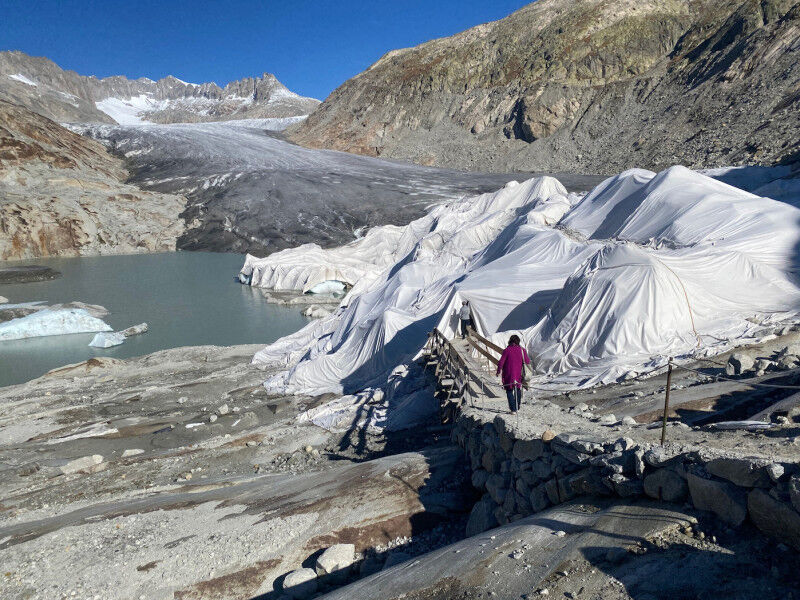
The analysis highlights the problem of the rise of "last chance" tourism. A fascination with what is disappearing, which paradoxically degrades the ecosystems we come to admire. On some sites, this has led to the construction of new access footbridges, the installation of geotextile tarpaulins, or even the offering of helicopter tours around glaciers. The latter practice reveals the tourism sector’s potential for maladaptation.
Often motivated by economic considerations, these solutions often fail to raise awareness of the root causes of glacier loss, or to address issues of safety or access to water for local communities. "Particularly in regions such as Alaska, Greenland and Antarctica," explains Emmanuel Salim, first author of the study. "Some tourists will thus simply move on to the next popular destination, once the glaciers have disappeared. "
Cultural and political symbols
At the same time, a "dark tourism" is developing, where fascination with glaciers is linked to a desire for understanding and commemoration. Civic action is being taken in the form of funeral ceremonies (in Switzerland, France, Nepal and Iceland), awareness-raising sportingevents such as the Glorious Glacier Ride, or petitions to ban access to certain peaks, as in India with the Stok Kangri.

These rituals and initiatives show that glaciers have become icons of climate issues, generating ecological mourning processes. They are also cultural symbols and political catalysts. In Switzerland, for example, the Glacier Initiative has helped to enshrine the objectives of the Paris Agreement in law.
One of the key questions will be to understand whether, and how, the disappearance of these icons can actually bring about systemic change, transforming sadness, anxiety and curiosity into collective responsibility.
Glacier loss as a wake-up call?
In view of the complexity and urgency of the situation, scientists are stressing the need for research to assess the effects of adaptation strategies on tourism and culture.and cultural adaptation strategies, and their effects on local ecosystems and communities (access to water, distribution of economic benefits from glacier tourism, etc.).). This work should integrate issues of social justice, environmental health and governance. Analysis is also needed to understand the public’s motivations, and how these visits or rituals might enable them to better grasp current phenomena, become more aware of environmental issues, and adopt responsible, sustainable behavior.
"In a world where 60% of ice volumes could have disappeared by 2100, we also need to assess and anticipate how recent post-glacial zones can be managed and protected," comments Emmanuel Salim. "One of the key questions will be to understand whether, and how, the disappearance of these icons can actually bring about systemic change, transforming sadness, anxiety and curiosity into collective responsibility. "
Source : E. Salim, A. Varnajot, M. Carey, K. Gagné, G. Hoogendoorn, C. Howe, M. Huss, C. J. Lemieux, E. J. Stewart, Melting glaciers as symbols of tourism paradoxes, Nature Climate Change, 2026