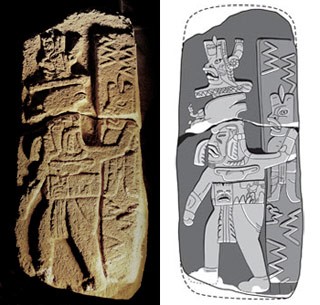
This photo and drawing illustrate a recently discovered 3,000-year-old Olmec-style stone monument from Ojo de Agua, the site of an early planned settlement in what is now the southern Mexican state of Chiapas. The carved monument provides information about Olmec culture in the area and includes symbols of maize, deities or other important figures, and possible features of the natural world.
Photo: John Hodgson; Drawing: Kisslan Chan and John Clark, New World Archaeological Foundation
With one arm raised and a determined scowl, the figure looks ready to march right off his carved tablet and into the history books. If only we knew who he was — corn god? Tribal chief? Sacred priest? "It's beautiful and was obviously very important," says University of Wisconsin-Madison archaeologist John Hodgson of the newly discovered stone monument. "But we will probably never know who he was or what the sculpture means in its entirety." The man is the central figure on a stone monument discovered in 2009 at a site called Ojo de Agua in far southern Mexico in the state of Chiapas along the Pacific coast. Hodgson, a doctoral candidate in anthropology at UW-Madison, describes the new monument in the cover article of the current issue (December 2010) of Mexicon, a leading peer-reviewed journal of Mesoamerican studies. The article, titled "Ojo de Agua Monument 3: A New Olmec-Style Sculpture from Ojo de Agua, Chiapas, Mexico," is co-authored with John E. Clark, of Brigham Young University, and Emiliano Gallaga Murrieta, director of the National Institute of Anthropology and History in Chiapas. Monument 3 is just the second carved monument found in Ojo de Agua. Monument 1 was discovered accidently when a local farmer hit it with a plow in the 1960s.
TO READ THIS ARTICLE, CREATE YOUR ACCOUNT
And extend your reading, free of charge and with no commitment.