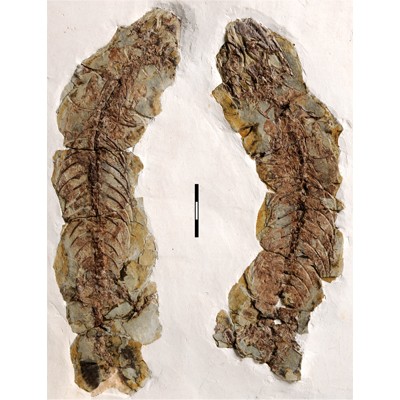
The pregnant gravid female Yabeinosaurus fossil. Credit: Susan Evans/UCL
A fossil from north-eastern China has revealed that terrestrial reptiles were giving birth to live young at least as early as 120 million years ago. The newly discovered fossil of a pregnant lizard proves that some squamate reptiles (lizards and snakes) were giving birth to live young, rather than laying eggs, in the Early Cretaceous period - much earlier than previously thought. The fossil shows a pregnant female filled with the tiny skeletons of more than 15 baby lizards at a stage of development similar to that of late embryos of modern lizards. The mother lizard, which is 30 centimetres long (excluding her tail), probably died only a few days before giving birth. The discovery is described in the journal Naturwissenschaften by scientists from UCL (University College London) and the Institute of Vertebrate Paleontology and Paleoanthropology at the Chinese Academy of Sciences, Beijing. 'Mention live birth and most people think only of furry mammals, but roughly 20% of living lizards and snakes also produce live young rather than laying eggs,' said Professor Susan Evans, joint lead author of the paper from the UCL Department of Cell and Developmental Biology. 'We previously thought that lizards adapted to live birth after mammals, but now it looks like it happened at roughly the same kind of time.
TO READ THIS ARTICLE, CREATE YOUR ACCOUNT
And extend your reading, free of charge and with no commitment.