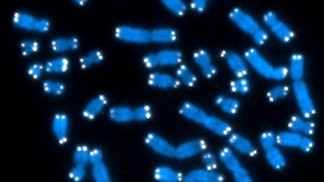
 The telomeres can be seen as white dots on these chromosomes© National Institute of Health
In cancer cells, normal mechanisms governing the cellular life cycle have gone haywire. Cancer cells continue to divide indefinitely, without ever dying off, thus creating rapidly growing tumors. Scientists have discovered a protein complex involved this deregulated process, and hope to be able to exploit it to stop tumor formation in its tracks. All our cells come equipped with an automatic self-destruct mechanism; they are programmed to die after a certain number of divisions. This internal clock is of great interest to cancer researchers, because most forms of cancer exhibit a defect in this innate timing mechanism. Cancer cells continue to divide indefinitely, long past the moment at which a normal cell would self-destruct. A team of researchers from professor Joachim Lingner's laboratory at EPFL has learned how this defect is regulated in a tumor. Post-doctoral researcher Liuh-Yow Chen led the team in publishing an article appearing on the 4th of July 2012. Their hope is that the discovery will provide new targets for drug therapies to combat the deadly disease. Cellular immortality, which is responsible for cancer formation, hearkens back to a critical function of the cells of the developing embryo. At the ends of every chromosome there is a special sequence of DNA known as a telomere, whose length is governed by the telomerase enzyme. This sequence represents the lifespan of the cell. Every time the cell divides, it is shortened, and when the telomere finally runs out, the cell dies. This reserve allows most cells to divide about 60 times - sufficient for the cell to play its given role in the organism, without succumbing to inevitable genetic mutation. Cellular immortality, cancer's common denominator
TO READ THIS ARTICLE, CREATE YOUR ACCOUNT
And extend your reading, free of charge and with no commitment.
Your Benefits
- Access to all content
- Receive newsmails for news and jobs
- Post ads